EAST-WEST
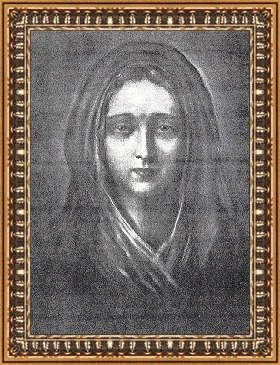
THE KITCHELL COMPOSITE MADONNA
A merging in one marvelous face of 300 of the most important Madonnas painted by the great Masters for the past thousand years. This inspiring and unique result of the union of science and art took the artist, Mr. J. G. Kitchell, over thirty years to complete.
RESURRECTION—By Swami Yogananda
Thought is infinite. Every word represents an ideal conception of the Infinite, because behind every word and thought is a manifestation of the Infinite. Many waves of thought are dancing in the waves of consciousness, but behind that there is the great unceasing ocean of Truth. Our expressions are waves of the ocean of understanding.
Resurrection—what is its meaning? It is life! To rise again! To rise to life! To rise—what and how? We must understand that resurrection means to live again. Every thing is undergoing a process of change. Then changes are either detrimental to the object which changes or are beneficial to it. For example, if I take this glass and strike it on the floor it would be changed, would it not? It would not be a beneficial change; it would be harmful to this object. But if I polish it up and make it shine, and clean it from bacteria, then that change is beneficial. Resurrection means any beneficial change that happens to an object or to a human being.
Now we are talking about human beings. You can resurrect your old furniture in the carpenter shop. You can resurrect your house through architects. We are talking of resurrecting the human body, and resurrection means any uplifting change. You cannot sit still because you must either go backward or forward. Isn’t that a great thing—a marvelous truth that in this life you cannot remain stationary? Either you must accept changes which are harmful to yourself or which are beneficial to yourself.
We say that every human being is an expression of the great vast Spirit. Isn’t it marvelous when we see how we human beings, without any motors, without any wires, without any visible electricity, run smoothly? The human machine wakes up in the morning, eats breakfast, goes to work, goes to lunch and eats again; goes back to the office, has dinner, then it goes to the movies, then goes to sleep, then it wakes up again and does the same thing all over again day in and day out.
We are controlled by something like radio-active and vito-active energy let loose by God! Just as ships are radio-operated, so we are controlled by the Infinite Spirit which is present everywhere. But the thing is this—just as the sunlight falling on the water in a glass which I keep moving becomes divided into a million suns, so the Spirit reflected in each human body and mind has been reflected as individualized Spirits or souls. Now though this soul reflects spirit, still, being identified with the body, it is trying very hard through processes of evolution to resurrect itself from the cage of the body, from the thralldom of the body and mind. The soul wants to return to the Spirit. If I had a cup filled with water and I held it under the lamp and moved the water, I have only a distorted reflection of the light in it. That is not the real light, but it may delude you into thinking that the light is real. Resurrecting the reflected image signifies taking it away from the moving cup of restless consciousness and reuniting it with the original all-pervading light.
Soul is reflected from the Spirit in the body and it is caged by the body, so it has all the limitations of the body and the mind. We must resurrect the soul from the thralldom of the body and the mind and unite it with the Spirit. It is easier said than done, isn’t it?
There is a story that Bernard Shaw met God in Heaven and said to Him, "Don’t you remember me? I introduced You to crowds in big halls and sent them up to heaven by the carloads." Than God said, "You sent them all right, but none arrived here." The thing is, sometimes we pray theoretically. We have resurrected ourselves from our blemishes according to our imagination, but facts are different. Resurrect yourself! It must be not only theoretically but practically. Even theoretical prayer is better than nothing at all, but sometimes it is a detriment to practical understanding.
Let us study first about mental resurrection. In the beginning of our life the soul begins to play with the body and gradually becomes the slave of the body. We must learn to live the life above the physical. Mental development is the by-product of physical development. We find according to natural evolution that the soul resurrects itself to the plane of intellect or plane of prosperity, and then rises to the plane of spiritual realization which gives a meaning to all prosperous development and intellectual attainment. Intellectual attainments are undoubtedly helpful—all good things help. Gradually we understand the way how to resurrect the body into the Spirit.
Resurrection means to resurrect the soul from the cage of ignorance; to lift it, to release the soul from the bondage of human life. Human life may be very beautiful, but it is just like a bird of paradise in a cage. You open the bird’s cage but due to love it may stay in—it does not want to fly away; but is that not a pity not to want to go out into the open from whence it came? It is afraid—and we, in meditation, say, "I am slipping—will I slip into the Infinite and never come back?" We are afraid of the skies. We have lived too long identified with the body. That is why we are afraid of our own infinite omnipresence—afraid to resurrect our omnipotence—afraid to resurrect our omniscience.
Bodily Freedom Not Real Freedom
To resurrect our wisdom from the bondage of body is spiritual resurrection. I will talk of body resurrection now. The next thing I have to say is about living dead people walking on the streets. So many think they are free because their hands and feet are free and they walk on the streets of a city free. They think they are free, but they are not free. They are in bondage—in chains—like men walking in sleep. If you have not been able to resurrect yourself form the bondage of sickness you are still imprisoned behind the bars of matter. To resurrect yourself from disease by right living is extremely necessary. By deep study, after many years, I have found out in a nutshell how to express health—by contacting Cosmic Energy.
We must also understand about food values. Carrots contain valuable vitamins. Wash them but do not do anything else to them. I ordered some raw carrots at a place I was visiting and when they were brought in they didn’t have any heads or feet. The tops and bottoms contain the vitamins. Meat is not worse than a cooked vegetable dinner of killed vitamins. Resurrect your mind from the bad habits of wrong eating. Start with the carrots. Don’t forget them. They are hard and nice—you have not to chew bones to get strength. When you chew carrots they give power to the teeth. The vitamins are in the top. Vitamins are sparks which set the gunpowder of chemicals in motion. Vitamins are absolutely necessary to the system for the harmonious development of physical strength. Vitamins are the brains of the food. Vitamins are rearranged in the system to give vitality to the body.
A lemon a day; an apple a day; an orange a day; half a glass of orange juice with two tablespoonsful of ground nuts; eight leaves of raw spinach. My mind said I must eat it but my palate rebelled against it. I am a believer in facts, so I chopped the spinach leaves very fine and added orange juice, and it makes a wonderful dish. Then you will know you are eating spinach. When you cook it the vitamins are all gone. I have never felt better in my life. I have very strong muscles now and of course Yogoda and not only food helps that. Grapefruit is very good. Then a little piece of banana—about one-fourth. Then unsulphured figs and raisins. Eat these things every day.
I recently met a man called Uncle Billy Ries—79 years old. He has grown a head of hair on a perfectly bald head. He said that he had been for years carrying a bay-window in front and was given up to die at 25 years of age. He resurrected himself—he began to think if there is a God ...He has no business in making me sick—then to think it ....must be his own fault. You see, he was resurrecting himself form the disease which had been constantly coming to him ....through his own fault. He found that sixteen elements are necessary to the body. You have a whole meal often but a starvation diet; whole meals of white bread and sugar and pies might satisfy but would kill in a few months. When you have to eat why not eat rightly? So he dieted and got back his health completely. He kicks way up high in the air and he successfully wrestled with me. We are great friends. Much valuable health information I owe to him.
The ordinary figs and raisins are mummies. They are so fixed that they do not decay, but have no life. These figs and raisins you can write in your will and leave to future generations as heirlooms. sun-dried figs only live three months. In the mummy kind the sulfur fumes are passed through them and kill all the vitamins. Isn’t it too bad to preserve things and kill the good part? Four unsulphured figs and prunes and a few raisins a day are good. Then you need a half or a fourth glass of milk or a boiled egg. It is good to boil eggs hard because there may be germs through the hen’s being sick. One-half glass of orange juice with ground nuts. Then one-fourth glass of buttermilk, a little piece of cheese, a piece of whole-wheat bread with butter or nut margarine. Nut margarine is very good. I do not mean that you shall live only on this, but you may eat more or less. But if you remember these rules you will not be making any transgression on nature. This has been only after years of experiment I have found all this out. I shall broadcast this information. Nature will not listen to excuses of your years of transgression against her health rules. If you eat sensibly, then if you are in the habit of breaking some laws occasionally, it will not so much hurt you.
So resurrect yourself from the bad habit of eating wrongly. A rattlesnake gives you warning—but gravy and white flour don’t tell you. The gravy and white flour look very nice. Everything white is not always good—sometimes brown things are very nice. We used to have unprocessed cereals until the mills came and we began to refine things, and now by a round-about way the best is taken out of the grains. Colonic poisoning comes with white bread. You cannot afford to have constipation. Stomach exercise of Yogoda is marvelously efficient.
Another thing, every week you must fast one day on orange juice to rest the organs. You won’t die—you will LIVE! Each month fast two or three days consecutively, living only on orange juice. There is so much bondage to matter—of fear to miss a meal. It is so evident we are not living by the Spirit of God. Jesus Christ talks about living by the Spirit of God. Resurrect yourself from this bad mental habit of overeating and palate slavery. When you fast on orange juice it scrubs every cell. At least every month you should give a thorough house-
cleaning to your body by fasting. Do not let poison accumulate in your system. When you are suddenly sick you begin to pray to God. Don’t let yourself get sick. The greatest way of health and the simplest is, every week fast one day on orange juice and two or three days consecutively a month.
Resurrect your soul from the hypnosis of bad habits in eating. You must do lots of resurrecting in order to get to God. Not only right eating but moderation in all things and sunlight and exercise are just as important. Then comes the question of resurrecting yourself from the consciousness of disease. That is more important than even meditating or trying to seek a remedy when you are sick. According to experiments of German scientists, many people are better because they do not analyze themselves or suffer from mental discouragement. There is a close relation between the mind and the body, and destroying the consciousness of disease is important. Many times diseases have left us and our consciousness of disease brings them back again.
In a village a saint lived. He was meditating in the night, when he saw a ghost of smallpox entering the village. He said, "Stop, Mr. Ghost, go away. You cannot molest a town in which I worship God." But the ghost said, "I will take only three people according to my cosmic karmic duty." The saint unwillingly had to nod assent. The next day three died, but the day after more died, and so on, more and more, until hundreds had died. The savant, thinking of the deception played on him, meditated, and the ghost came. The saint said, "Mr. Ghost, you deceived me and did not speak the truth." But the ghost said, "By the Great Spirit, I did speak the truth to you." Then the saint said, "You promised to take only three and your have taken hundreds." The ghost said, "I took only three, but the rest killed themselves with fear."
You must resurrect your mind from the consciousness of disease—from the thought of disease. You are reflecting invulnerable spirit. The body rules the mind but the mind must rule the body and then the body will not accept suggestions of environment and suggestions of heredity. Wrong ways of physical living have been handed down to posterity. Diseases exist only when you stimulate the thought of the forefathers and thereby reinforce their ignorance. You must always remember that if the Spirit takes away the radio-active energy then you would drop just like that. So if God takes away the energy, with all your dinners and all your society and money, you cannot live; so remember that you are living by the power of God. You must give the whole credit to God that you are directly living by His power. You do not care about difficulties—you are not afraid. Resurrect yourself for the consciousness of diseases that have been handed down by your forefathers. God never created disease. These are the truths which have been preached in India ages ago. Truth that shall make you free!
Then comes resurrection from our own mental habits. You know that the silk worm weaves threads around itself into a cocoon. Before it slips out of the cocoon into a butterfly, the silk man gets hold of him and the silk worm finds its death in the prison created by itself. We do just like that. Before the wings of spirituality grow, we foolishly weave the threads of fear, worry and ignorance around ourselves until disease and death come and destroy us. We find ourselves in the bondage created by ourselves. What is most destructive? Our own thoughts, our own wrong ways of living, thinking first and then doing. We must resurrect ourselves from the thought of anger, from the thought of selfishness, from the clamor of inharmonious living.
"Let the Dead Bury Their Dead"
Many people think they are awake, but they are not. Mostly they are walking deads. Have you ever heard of people walking in sleep, crying fire or lecturing? Most people are like that. I don’t mean Yogoda students or those who are living the life of truth. Jesus said, "Let the dead bury their dead." Because one was to be buried beneath the soil and one was already buried beneath the soil of ignorance. So the thing is this—resurrect those who have buried themselves under their wrong living. You must be able to smile in order to do that. Not like this: "I am DEElighted to meet you," not that kind of smile. When you smile—when God smiles through the heart, through the soul, when the soul smiles through the heart and the heart smiles through the eyes, then the prince of smiles is enthroned beneath the canopy of your celestial brow. Let no rebel hypocrisy ever destroy it. Smile when the storms of suffering shock themselves around you. Say, "I have launched my boat on a dark sea, I have heard Thy call, Thou knowest that I am coming." He knows that you are on the sea of trials; He knows that you are moving your bark. He knows that you must battle these storms that are around. You are clouded through self-ignorance because you don’t see the Spirit around everything. That is why you must resurrect yourselves, your souls, from the trials around you. You must always say, "I have launched my boat on the sea of sunshine. I, through my mental radio, am sending the vibration that I am coming." You must battle even when the hands seem to break, you must battle, you must not give up. Then, when the clouds will finish and the life of happiness and prosperity will be back again, you will forget your trials.
Trials are not sent to you to destroy you but come that you may appreciate God better. God does not send those trials; they are of our own making. All we have to do is to resurrect our consciousness form the environment of ignorance. Environmental troubles, which we consciously or unconsciously have been creating in the past somewhere, some time, we must blame ourselves for. There must not be an inferiority complex. You must say, "I know You are coming! I will see Thy silver lining. In this tumultuous sea of trial Thou art the pole star of my shipwrecked thoughts." What are you afraid of? You are not a man. You are not what you think you are; you are the immortal. Not immortality identified with human habits—habits are your deadliest enemies. In crucifixion Jesus could keep His love and say, "Father, forgive them, for they know not what they do." So forgive your trials and say, "My soul is resurrected; my power is greater than all my trials, because I am the child of God." All those who receive God develop their mental powers by serious application. Your mental powers will expand, your cup of realization will be big enough to hold the ocean of knowledge. Then you have resurrected yourself.
Resurrection was celebrated last Easter. Jesus gave a great example. People that you do good to turn around and slap you. Expectation is meanness, is littleness. Give and forget. If your neighbor slaps you, just say he does not know any better, but don’t say it loudly. Resurrect yourself from the littleness of life, little things that disturb you. Do you think you are completely unbalanced, ruffled, shattered, whipped, lacking power? No. You have power; you don’t use it. You have all the power you want. There is nothing greater than the power of the mind. Resurrect your mind from the little habits that all the time keep you worldly. Smile that perpetual smile—smile of God. Smile that strong smile of balanced restfulness—that billion-dollar smile that no one can take from you.
I was on my way to Los Angeles once and met a man for whom I felt sorry. I thought, "What is the matter with this man? I must resurrect him. He has buried himself beneath this artificial habit of gloom." I said, looking at him, "Are you happy?" He tried to kill me with a gaze. I looked straight at him. What have I to fear? Nothing. He said, "Is that your business?" I thought, he had killed me in his mind and he could not kill me more. He said, "Yes, I am happy." I said, "No, I can tell what is in the mind." I call a spade a spade. He said, "Why shouldn’t’ I be happy? I put fifty to sixty thousand dollars a month in the bank." I thought, "Poor soul!" I said, "Tomorrow you may not be here to carry a cent. Have you opened your bank book with God?" Later he invited me to lunch, but he was inwardly antagonistic to me. Then we talked and he loosened up. I said, "Don’t rely on riches. You may die and not have even a chance to make a will. These material riches are not yours. Open your bank book with God." He said, "Meet me in Boston." I said, "Meet me in Los Angeles." but he did not have time. Then in Boston I was at the hotel where he stopped and the hotel manager said, "Don’t you know what happened to him? He was coming from a hockey match and was struck down by a truck and never regained consciousness." I felt very badly. See, he waked up a little bit but not enough.
If you have assurance with the Infinite, you will know, whether or not nature shatters your body, you are still on the lap of immortality, still on the lap of that Infinite assurance. Resurrect yourself from the consciousness of human habits and the human thoughts thereof. Every second live in that consciousness—it is the last thing, that which alone will live forever. This is not to frighten you but to quicken your understanding, quicken your efforts—that you do not keep your soul buried under false satisfaction.
Open your bank book with Him—it shall never be lost. You can use it through all your travels in eternity, whether in an airplane or an astral plane. You should say to yourself: "From star to star I will fly, whether on this side of eternity or the other side of eternity, or surging thru the waves of life, from atom to atom—flying with the lights—whirling with the stars or dancing with human lives! I am the immortal! I have resurrected myself from the consciousness of death."
Resurrect yourself from anger, from melancholy, from failures. You must succeed to know that you are God’s child. Success is not limited to spiritual matters. Success must come in everything. Resurrect yourself from the consciousness of disease, from mental habits and weakness. Have a strong smile which shall never be shattered by the trials of your circumstances. Then comes spiritual resurrection. Resurrection means relaxation—to relax yourself from your body. As you relax yourself from your mental body in meditation, so you must relax yourself from the internal organs, and body consciousness. Then you become free; your soul knows that you can live without the body though living in the body; it can say it is separate. Resurrection does not mean a change only after this mortal change. You must resurrect yourself while in this body. You resurrect yourself every night in sleep. Sleep is unconscious resurrection. You must do that consciously in meditation—meditation is conscious resurrection. Some of our saints in India have been buried and brought back alive after several days under the ground. They have proved that resurrection is possible. To do without food and still live, that is conscious resurrection. Resurrection of Jesus Christ is different. It is still higher. Resurrection means you understand creation—how to free the soul from the bondage of ignorance.
Right Understanding is Necessary
We have no existence but in the universal. The body you see is nothing but materialized electricity. How could electricity be sick? It is a delusion. But simply saying it is delusion is not enough. If in a dream you see a wall and you see your body strike the wall, you will have a broken skull in dream. Yogoda says it is only by coming in contact with God that one sees that God is the universe and that the body is nothing but condensed electricity. Science has said that electricity is nothing but energy or frozen cosmic consciousness. We must not call it mind. Mind is different. To say everything is mind is wrong. It is cosmic consciousness which makes us feel different things; consciousness of matter and consciousness of spirit. I have written plainly in joy "Scientific Healing Affirmations" why it is we do not see Spirit in matter. Jesus Christ had the power to see it. Resurrection means not only to resurrect body and soul to another sphere of existence, but to change the atoms of the body as well as spiritualize them and release them along with the mind. Everything—skin, hair, eyes—is nothing but frozen energy and frozen consciousness of God. Peter took off the ear of the centurion and Jesus healed him. Why? Because he knew that the atoms were controlled by the Consciousness of God and atoms obey Him. They do not obey you—why? Because you are not controlling that cosmic consciousness which is holding this flower together as a flower. You have the illusion of solids. By meditation you will first be able to separate the soul from the body. The cosmic golden cord that binds the atoms is the tender Spirit. It is His cord with which He binds the atoms and they become the flower, or the human body. He takes lots of electrons like a child modeling in clay models, and He throws them into eternity and they are stars or universes. We are very little to Him—I think nothing more than bacteria. We are very small but we are very big!
A little story—about bigness. It is that though we think our things are marvelous they are not big to God at all. I saw a big pile of snow and a very little ant crawling along. I thought it must be thinking of scaling the Himalayas. It was Himalayas to the ant but not to me. A million of our years may be a couple of years in the mind of God. We must think everything in terms of bigness—eternity—space.
The Crucifixion of Self-Sufficiency
Last of all, resurrect your mind from formal faith—faith which may have given you a little satisfaction but which you have outgrown; religions which you lived with under the conviction that you know—while you don’t know. The greatest crucifixion of the soul is the crucifixion of self-sufficiency—when we are thinking of how wonderfully big we are. Your soul must be relaxed from the bondage, the littleness of the body and the sufferings that the body is subject to. When you think of these diseases you think of the injustice of God, but KNOW you are immortal—not to be crushed by the mortal lessons but to learn and show your immortality and SMILE. Say: "I am immortal, sent to an immortal school. I am challenged by all the fires of the earth—I cannot be destroyed. Fire cannot burn me; water cannot wet me; breezes cannot blow me; atoms cannot shatter me; I am the immortal dreaming the lessons of immortality—not to be crushed but to be entertained." In the dreamland, sickness and health are the same—prosperity and failure are the same. A dream of prosperity is better than a dream of failure. Why not dream prosperity if you have to have dreams? You must have good dreams in this life. If you have too many bad dreams you will be very busy crying and not have time to know that it is all a dream. The dreams of health and prosperity and wisdom are better.
Resurrect your soul from the dreams of frailties. Resurrect your soul in eternal wisdom. What is the method? Relaxation! Self-control; right diet; right fortitude; undaunted attitude of the mind. Refuse to be defeated. Don’t acknowledge defeat. To acknowledge defeat is greater defeat. You have unlimited power—you must cultivate that power, that is all. Meditation is the greatest way of resurrecting your soul from the bondage of body and all your trials. Meditation! Meditate at the feet of the Infinite. Learn to saturate yourself with Him. Your trials may be heavy, may be great, but the greatest enemy of yourself is yourself! You are immortal, your trials are mortal; they are changeable, you are unchangeable. You can unleash the eternal powers and shatter your trials.
Two frogs—one a big one and the other a small one, feel into a pail of milk. The sides of the pail were shiny and smooth. The frogs were battling—every time they lifted their mouths to catch a little oxygen, down they went. They kept on battling. After a while the big frog gave up and was dying but the little frog said, "Well, life is too sweet. I don’t like to die. I will keep battling no matter if my little feet fall off". So it was battling for hours, when suddenly it found something solid under its feet—the milk was churned to butter! Out jumped the little frog! That is just how life is! After battling insufficiently like the big frog, you deserve dying; but if you keep on battling with determination, your difficulty will burn up—some answer from the Infinite will come and you will hop out of your difficulties. Be like the little frog. By all means keep battling. Determination! Resurrect yourself form weakness, disease, ignorance, consciousness of disease, and above all from frailties of habits that beset your life.
_________
—By T. L. Vaswani
I:—Bird! Brother Bird! Why so swiftly
Must you speed on wings of wind?
BIRD:—Some one calls me lovingly,
—Waits for me yearningly.
I:—Who?
BIRD:—Yon blushing flower.
I:—What is he to you that you speed to him Leaving me, brother Bird!
BIRD:—Yon flower is a child of my song.
I:—Why blushes yon flower?
BIRD:Because his heart has memory of me.
I:—He has no brain for memory.
BIRD:—Your "Brain" forgets;
’Tis the Heart remembers.
I—What does your heart remember,
Brother bird?
BIRD:—One only wisdom,—Love.
I:—Why do you sing the whole day long?
BIRD:—In Remembrance of Love.
I:—Why won’t you do some work?
BIRD:—What nobler work than this, to weave Songs of Love?
I asked the Sea:—
"Where is He?"
And the Sea answered:—
"I, too, am in quest;
Hence my deep unrest!"
I asked the Wind
Rushing past the plain:—
"O thou that sighest!
Tell me where is He?"
"I, too, wander after Him;" she said.
I asked the Rain
In pearl-drops descending;
And the Rain answered me:—
"For the Fairest One
I weep these showers of tears."
I asked the Flame;
"I flicker in His quest," she said;
I asked the Dawn.
She blushed and answered me:—
"Pale am I in quest of Him."
I asked the Nightingale
Singing his plaintive notes
In Rose Garden of the King;
And the Nightingale said:—
"I sigh out my song for Love."
What abides?
The offering of Sacrifice.
What goes?
The things we hoard.
What hunger is the best?
The hunger for the Beautiful.
What business is the best?
Spending love to buy joy-beams for the poor.
What friends are the best?
Nature’s simple things,
—Flowers and the light of stars.
What worship is the best?
Silence at Love’s feet.
Why fades and falls the Rose?
A sacrifice to Spring.
Why sings the song-bird in the tree?
In witness of the Truth that is Love.
Why gravitate these petals to the ground?
They listen to the Flute and fall at His Feet.
Why plays Krishna upon the Flute?
It hath renounced itself and is pierced with holes.
____________
Creeping inward, creeping upward
Diving deep within, we find
Treasures lasting and uplifting;
Best of all, that Peace sublime.
Many lives we’ve spent in serving
Senses, passion and mind’s whim,
And have missed our own true Being,
Oneness with the God within.
Let us therefore give this one life
To the fight for higher gain,
With the hope, when life stops ebbing
That the task was not in vain.
O! Great God above in Heaven
Hear our cry we pray tonight,
Keep us steadfast in Thy wisdom
Keep us always in Thy light.
___________
"By religion or spiritual conviction,
I do not mean blind faith in a ceremony
Or a cross or a creed. I mean apprehension
Of the fact that I shall always live
As truly as I live now,
And that I can better my condition."
William the Conqueror, King of England and a great warrior and leader of men, was once a visitor at the famous health resort of Salerno in Italy. The health principles of this medical center, which was established in the 10th century, were rhymed in Latin for William’s benefit. The following English translation of part of the Salerno credo deals with the importance of right diet.
(Dyet):
"The Salerno Schoole doth by these lines impart
All health to England’s king, and doth advise
From care his head to keepe,
From wrath his heart,
Drink not much wine, sup light, and soone arise,
When meate is gone; long sitting breedeth smart;
And after-noone still waking keepe your eyes.
When moved you find your selfe
To Nature’s Needs,
Forbeare them not, for that much danger breeds,
Use three Physicians still; first Doctor Quiet,
Next Doctor Merry-man, and Doctor Dyet."
* * *
"To keepe good dyet, you should never feed
Until you finde your stomacke cleane and void
Of former eaten meate, for they do breed
Repletion, and will cause you soone be cloyed,
None other rule but appetite should need. . . ."
* * *
"Good dyet is a perfect way of curing;
And worthy much regard and health assuring.
A king that can not rule him in his dyet
Will hardly rule his Realme in peace and quiet."
____________
—By G. A. Studdert-Kennedy
It was not death to me,
Nor aught the least like falling into sleep.
It was nothing to joy upon
Nor yet to weep.
It was an infinitely perfect peace
Wherein the world entranced
Stood quite still
Outside of time and space;
And like a changeless, ever-changing face
Looked kindly on me
As I lay
And waited on his will.
It was not night
Nor day—
But bright with rainbow colours
Of an everlasting dawn
Down from the golden glory light
That shone in His great eyes.
The mysteries of earth
Lay open like a book,
And I could read
But slowly, as a small child reads
With an often upward look
That pleads
For help—still doubtful of the truth
Until he sees it mirrored
In the answering eyes of Love.
So I looked up to God
And while I held my breath,
I saw Him slowly nod,
And knew—as I had never known aught else,
With certainty sublime and passionate,
Shot through and through
With sheer unutterable bliss.
I knew
There was no death but this
God’s kiss.
And then the waking to an everlasting Love.
—The Morning Post, London.
____________
DEATH—Frederick Lawrence Knowles
This body is my house—it is not I:
Herein I sojourn till, in some far sky,
I lease a fairer dwelling, built to last
Till all the carpentry of time is past.
When from my high place viewing this lone star,
What shall I care where these poor timbers are?
What, though the crumbling walls
Turn dust and loam—
I shall have left them for a larger home.
What, though the rafters break,
The stanchions rot,
When earth has dwindled to a glimmering spot!
When Thou, clay cottage, fallest, I’ll immerse
My long-crampt spirit in the universe.
Through uncomputed silences of space
I shall yearn upward to the leaning Face.
The ancient heavens will roll aside for me,
As Moses monarch’d the dividing sea.
This body is my house—it is not I.
Triumphant in this faith I live, and die.
The inspiring story of the ancient Hindu King, Sikhidwaja, and his wonderful Queen, Chudalai, is beautifully related in "Yoga-Vashishta" by Valmiki, and translated from the Sanskrit by K. Narayanaswami Aiyar. The story outlines an ideal marriage, as well as the most sublime development toward the spiritual goal of life. The translation runs thus:
"He (King Sikhidwaja) had cultivated mental and bodily restraint and other powers of will, and especially delighted in doing good to others. The partner of his marriage was Chudalai. . . . These two lived together in perfect happiness with their two minds interblended, performing all actions without the least difference of opinion, having mastered all the departments of knowledge. Delightfully indeed they passed their youth, as if but one breath of life pervaded in common their bodies. As the years glided sweetly by, their ephemeral youth passed away like water form a broken pot, and middle age fell upon them like flakes of snow on lotuses in the waters of a rivulet. Like water trickling from the palm of the hand, so their leaves sped away, day by day. Then the desires, which had in youth expanded themselves more and more like a gourd plant that grows in the rainy season, ever winding itself round and round, began to lessen like waters in the time of autumn. All the pleasures that once arose in the body now darted out of it like arrows from a bow. Just as a plantain tree grows useless after is has put forth its fruit-bunches, so they became indifferent to worldly actions after tasting of their fruit. In unison of heart, they both began to contemplate. . . .
"Coming thus to the conclusion that rebirth cannot be avoided except through Atma-Jnana (knowledge of the Eternal Self) alone, both betook themselves to such a life with their minds absorbed in it and with true meditation. And for the attainment of their wish they ever associated with the wise and learned. Thus did they live long together, exulting over their store of accumulated knowledge and leading a practical life of spirituality in accordance with that knowledge. Then the Lady Chudalai, of true discrimination, having heard and clearly understood the real signification of the Sastras taught by the wise for the attainment of the different stages leading to the realms of the higher spirituality, thus began to commune with herself. . . .
"And thus it happened that through her divine introvision the queen enjoyed daily the consciousness of the reality of Atma (the Eternal Self) and remained steadfast in that condition. Also, through the strict performance of her daily actions without the least longing after their fruits, all her desires and the tendency of her mind towards objects entirely ceased, nor was she troubled by the ‘pairs of opposites,’ or love and hate. Thus in the performance of actions without attachment to result, her mind ripened and became the receptacle of bliss. . . . She shone with a radiant spiritual light and became like a soft tendril bearing flowers."
The king, noticing the spiritual splendor that shone round her, questioned her. But when she explained her perception of the eternal verities beyond this phenomenal world, his pride overcame him and he rebuked her, refusing to believe that she had attained to the changeless state of blissful realization that he had not been able to reach.
"Yet this couple continued to live together harmoniously and happily as before. Preserving as she did a perfect equilibrium of mind, the wife had complete mastery over her desires. But there arose in her, through her own volition, a desire to be a ‘walker of the skies’ (in order to convince her husband of her real powers, and so lead him into the spiritual path.) For this purpose, she freed herself from all pains arising from enjoyment and seated herself in a solitary spot, in a pleasant posture, in order to obtain enlightenment. . . .
"Being with Atma-Jnana, the King began to reel under illusion and gave way to grief, regarding the enormous wealth he had so easily acquired as destructive as a great forest-fire. He therefore gave various rare gifts, underwent many religious observances and bathed in the holy water; but yet he was not free from the load of grief in his mind. Sorely afflicted in heart, he drew to him his wife Chudalai, and poured forth his heart to her thus: ‘I have now
abandoned all love of sovereignty and wealth, and I desire to enter the forest life. . . . Let me no longer associate with the delusions of this earth. . . . Thou shalt reign over the earth unfailingly in my stead. When a husband goes from home, it is the wife’s duty to protect those around him and not to languish at his absence.". . . "Then, bidding adieu to his great but enslaving possessions, he entered into the forest, crossing, in the course of twelve days, many rivers and hills. At last he reached the inaccessible forest on the slopes of the Mandara Hills, and took up his abode there, in a spot surrounded by tanks replete with lotuses and other delicious flowers. There he erected a Parnasala (hut of leaves) and furnished himself with a bamboo-rod, a rosary for the recitation of Mantras (sacred chants), a cloth, vessels to hold fruit, etc., and deer skins. Then, in order to perform Tapas (austerities) in the first Yama (three hours), he performed the Sandhyavandana rites; in the second, he gathered flowers; in the third he performed worship to Devas; and in the fourth, he fed upon fruits fit for food. All night through he was engaged in the chanting of Mantras. Thus did the king perform Tapas.
"Chudalai resolved to find out the whereabouts of her husband, for the husband is the wife’s only goal. She sprang forth (in her double), and passing through the window, went up into the sky, journeying through the air with so bright a face that the Siddhas (semi-divine beings) in the skies exclaimed, ‘Lo, another moon has arisen here!’ Then, seeing her husband traveling in the forest with a bright scimitar in his hand, she meditated as to what course she should pursue in regard to him. Having done so, this sweet-tongued one came to the following conclusion: ‘It is but right that I should see him only after his love and hate have ceased.’ With that, she returned to her palace.
"This divine lady gave out to her subjects that her husband had gone to a certain place on matters of a private nature. So she wielded the sceptre alone for eighteen years with true regal justice and an equal eye to all, thus passing her time in her palatial mansion; while at the same time, the king eked out his life of suffering in the forest.
"Finding that the time was ripe for her to se her husband, she went forth one night and walked the skies. Having mounted on the shoulders of Vayu (air), invisible to all, she alighted on the Mandara Hills and saw there a decrepit and melancholy body, which, at first, she did not know for her husband; but having by her great powers of Yoga, discovered it to be none other than his, she yielded to her grief and gave vent to these words: ‘Lo! dire is Ajnana (ignorance)! Through it, the king is groaning in pain. I have undoubtedly the power to confer Atma-Jnana (divine knowledge) on him at this instant; yet, lest he should spurn me if I, his young wife, should appear in my present form, I will assume another form suitable to accomplish my end. Moreover, the king is now in a state of mind which permits of his Ajnana (ignorance) being dissipated. At a single word from me, Jnana (knowledge) will reflect itself in his now ripened mind.’
"Therefore, availing herself of this most opportune hour, she changed her bodily form by her incomparable Dhyana (powers) and descended from the Akasa (ether) before her husband under the form of the son of a great Brahman (highest casteman). The king at once arose, and paid him all due respect. This young Brahman had a beauteous form, and, upon his breast, was a garland of pearls; he wore a white cloth and a sacred thread; and stood in the air at some distance from the ground."
The newly-arrived Brahman, telling the king his name is Kumbha-Muni, proceeds to instruct him in divine lore. The king’s mind receives great enlightenment and with great joy, he accepts the young sage as his Guru (spiritual teacher). The king explains his presence in the forest thus:
"Being afraid of the worries of existence, I sought in this forest freedom from actions. . . having relinquished my regal duties. My mind stands aghast at this ever-recurring cycle of rebirths. Though I made Tapas (sacrifices) here after obtaining all things necessary for that purpose, I have but enhanced beyond description my pains in the endeavor to do away with them."
Then Kumbha-Muni, addressing the king, replied, "There will be true bliss only when the Jnana (knowledge) instilled into a disciple by the Acharya (Guru) truly fructifies in him. Are not all acts of Tapas (sacrifices and austerities) simply diversions to while away the time?. . . I can enlighten you only if you will concentrate your mind, which now runs quickly from one object to another, with singleness of purpose. Otherwise, the Guru’s words, taken lightly and not conceived and meditated upon, would be of no avail even though heard . . . I have to demand as a first condition that you, O valiant king, will hear my words without interruption, and in the full belief that they will conduce to your welfare, as in the attitude of an ignorant child that hears the words of its father who is solicitous of its well-being."
The Muni then told the king the following story of a man who sought the Chintamani ( a gem supposed to yield anything thought of). "Through the performance of rare Tapas (sacrifices), he came into possession of it after a good deal of trouble; for what cannot a man attain to, if he takes the necessary trouble? Now, when the gem appeared to him, shining with the lustre of the moon, he, without bringing it under his grasp, thus soliloquized: ‘I fear this is not Chintamani, but only some paltry stone. . . . I am but a man; my Tapas (sacrifice) is very insignificant, and my powers small. . . Therefore, can it be possible for poor me to behold the rare Chintamani before me? I will proceed to make a further search for it.’. . . After he had wandered for some days in a perturbed state, some Siddhas (persons possessed of psychic powers), intending to fool him, screened themselves from his view, and let drop in his path a broken piece of earthen bracelet, which he no sooner saw than he picked up. Then, this deluded man, mistaking it for the true Chintamani, began to exult in its discovery and to marvel over it. . . .
"What I intended by the story of Chintamani is this: In order to attain true renunciation devoid of all pain and hypocrisy, you (the king) have forsaken your regal office, your wife, and other relatives, wherein there was the true Chintamani, and have betaken yourself to this forest. While the true renunciation was developing itself little by little in you though in the world, your mind was led astray by undue zeal to a wrong conception of renunciation, and was enveloped by that delusion as by a dark cloud which obscures the sky. This renunciation of yours is not the true one, generating real happiness, which you lost track of, because you thought that this (renunciation in the forest), if persisted in sufficiently long, would, at length, give rise to the true one. Having lost the Chintamani gem of true renunciation, which is the proper path of life, you have been misled by the false idea of the burnt stone of Tapas (the false Chintamani—the earthen bracelet) through your faulty vision, and have, therefore, been greatly afflicted. The wise say that those who reject the happiness accessible to them in their daily lives and allow their minds to search after imaginary and strange things without limit, are only self-destructive and of corrupt thought. Through the (false) idea of Tapas (sacrifices in the forest) as the means of bliss, your mind in no wise acquired that peace it desired, even when the gracious and priceless Chintamani was before you (in the person of his divinely-enlightened wife Chudalai, who could have instructed him in the proper method to reach emancipation if he had remained in the world with her, attending to his proper duties)., . .
"True renunciation, O king, lies in the abnegation of the mind. It is this which leads to Brahmic bliss. All other renunciations cause us sufferings. If, after true renunciation, you are illumined in mind, with perfect quiescence and without hatred, then will the identification of yourself with the Self of Brahman take place, and you will shine with resplendent glory. . . They are the true vanquishers of the mind in the karmas which fall to them, controlling all thoughts and desires in regard to such. . . Therefore, if, through virtuous actions, you destroy the idea of ‘I’ at the root of the tree (mind), then it will not again spring up . . ."
"Then Kumbha-Muni, able to confer Atma (Self) upon the king, caused him to cognize it, and said: ‘The true discrimination of space, time, the spacious quarters, mental actions and the rest, is only to understand the universe in its differentiated aspects. Though these distinctions have been existing in you from a remote past, yet they will perish (in you) in a short time. The quiescent and indestructible Brahman (God) will alone be, (as you will presently cognize).’
Instantaneously the king attained Jnana (knowledge) and shone with it. Thus was he released from the fold of dire Maya. Then, through the grace of the Muni (sage), who was pleased to dispel the delusion (of the phenomenal creation) from his mind, he was absorbed into the Brahmic state. Being freed from the actions of his mind, sight and speech, he, in one moment, became the Plenum in Brahmic state. After he had been for two ghatikas (48 minutes) in that state of Nididhyasana (meditation), he awakened and the Supreme Muni said: ‘Have you enjoyed to the full, free from all pains, the Elysian bliss of Brahmic seat, which is the ever-beneficent, the stainless, the pure, the soft, the seat of all Nirvikalpas (non-fancies, i.e. reality) and the fullness of all wealth? Have you been illumined with Atma -Jnana? Have you been freed from all delusions? Have you known that fit to be known? Have you seen that fit to be seen?’
"To these questions the king made reply: ‘O Lord, through your grace I have been able to cognize that seat of Brahman, which remains after all else is over, which confers the divine wealth of bliss, and which is the grandest and the most transcendental of all. Oh, I have been able to acquire the otherwise unattainable heavenly nectar of great bliss, and move in the company of those great souls of powerful Brahmajnana (knowledge of God) through the blessing of association with your grace. How was it not possible for me, your humble servant, to attain this immeasurable supreme nectar before?’
"Kumbha-Muni said: ‘It is only when there is quiescence in the mind and an indifference in it toward all enjoyments, and when the powerful Indryas (organs) are turned inward and the Ajnana (ignorance) of the mind is destroyed, that all the noble words of the wise Guru will infiltrate and spread in the mind of the disciple, like the scarlet water of the forest impinging on a perfectly white cloth. Otherwise such words will drop down, like the impurities of the body or the fruits of a tree. The mere doubt arising in one’s mind of the existence of duality or non-duality in this world betrays Ajnana; the removal constitutes Jnana (knowledge). It (Jnana) alone is our highest goal. Through illumination, you have attained Moksha (emancipation). You have levelled down your mind. . .
"Like the waters of an ocean, all the Universes are nothing but the non-dual Chinmatra (Absolute Consciousness). When this Chinmatra draws unto itself intelligence, then there is a fluctuation caused, like the wide waters moved by great waves. But the ignorant without true Nishta (meditation) regard the Supreme Principle. . . as the universe itself. A slight motion in this Chitta (Consciousness) generates this universe. If this visible universe of objects is truly cognized as the Jnana bliss, then it will die. But when its real nature is not powerfully grasped, then the visibles are seen as real, as the (misconception of a) snake in a rope. Should the pure mind concentrate itself for some time (steady and pure as the moon) through (a
study of) the visible Jnana Sastras (religious scriptures), the association with the wise, and an uninterrupted practice (of meditation), then in such persons developing Jnana (knowledge), a divine vision will arise, in which there will be a direct cognition (of the One Reality). Thus have I described to you the truths relating to the origin and destruction of the Universe. Having with true bliss brought these into practice and meditated upon them, may you, without fail and according to your free will, attune all your actions of daily life to the attainment of the Brahmic seat. I now shall go to Svargaloka, the gem of all Lokas (worlds). . . .’
"And with the words ‘I go away’, the Muni disappeared on the instant. Thereafter, the king thus thought within himself: ‘Marvelously strange it is that this incomparable state was in myself unobserved by me—a state like unto the crystal waters of a fountain, cool, pure and quiescent. It has enabled me to attain quiescence in the Absolute Sat (Consciousness).’ Then the king entered the Samadhi (super-conscious) state without any pains or fluctuation, without any mobility, with a true mouna (silence) and Nirvikalpa (divine vision)—immovable as a stone, tree or forest, without any desires.
"Meanwhile Kumbha-Muni resumed the soft tendril-like form of (the queen) Chudalai, and journeying through Akasa (ether), reached her chamber in the palace. There she began to rule over her subjects and protect them as she was wont to do. Thus she passed three years. After which, she went again in the guise of Kumbha-Muni to the forest where her husband was, and beheld him as immovable as a pillar in Nirvikalpa Samadhi (divine vision). Then, in order to acquaint him with her arrival, she made a leonine roar, which even did not wake him up from his trance. Though she tossed him up and down, no impression was made on him in the least, in spite of his body falling down. Then she thought thus: ‘It is certain the king has merged into the seat of Brahman (God). O this is really wondrous. If, after concentrating my mind on his (subtle) body, I should find any residue of Satwa (one of the three principles of nature) typifying the seed of intelligence in his heart, I shall join my husband and live with him happily. Otherwise, I shall have to renounce this my present female form and attain the Supreme Seat of Brahman, so that I may not render myself again liable to rebirths.’ Having come to this sure determination, she concentrated her mind and cognized through her (spiritual) touch and eye a residue of unsoiled Satwa in the king’s heart, denoting the intelligence yet animating that body . . . .
"Like flowers and fruits latent in a seed, a residue of Satwa, the cause of intelligence, rests always in the heart (in order to keep life in a living form) . . . This most divine lady Chudalai gave up the Kunbha-Muni form and entering (in a subtle form) into the stainless consciousness (or mind) or the king, devoid of beginning, middle or end, caused that part of it to vibrate which she found had the residue of pure Satwa in it. Then she returned to her stainless body, like a bird returning to its prison of a cage. Afterward, as Kumbha-Muni, sitting in a certain posture on the earth, she chanted the Sama-Veda songs, as if playing on the Vina (as these methods alone could arouse the king to a consciousness of the physical world). Thereupon, the Satwic intelligence, which now began to manifest itself in the log-like body of the king, heard the Sama-Veda songs and blossomed little by little, like a lotus flower blooming at the sight of the rays of the sun. Then the king’s mind became steady (as regards external objects), and he saw Kumbha-Muni before him. With an enraptured heart, and with the idea that his Lord Guru, who had previously come to him in order to bless him with happiness, had come again of his own accord, he showered on him the choicest flowers and eulogized him . . . The king burst out, saying: ‘O transcendental and holy god, I have attained bliss through thy favour, I have liberated myself from all pains through the Samadhi of true bliss . . . Having attained that incomparable bliss, I shall roam freely in Devaloka (land of the
gods) and Bhurloka (earth).’ Kumbha-Muni then asked, ‘Have you been enjoying the rare Brahmic bliss devoid of all pains? Have you annihilated all the pains which are of the nature (or spring from the idea) of heterogeneity? Are you able to maintain an equal vision over all, after destroying entirely all the pleasure flowing from San-kalpa (various functions of the different branches of the mind)? Have you been able to transact all the present duties of life, without in the least being ruffled by objects, being liberated from love or hate toward them?"
The kind replied that he had overcome all delusion.
"Thus did these, whose love for one another knew no bounds, cognize their Higher Self through the beautiful enquiry of Atma-tatwa (nature of the Real) and through most instructive discourses thereupon; remaining happy in one another’s company, without the least difference of mind, and roaming in the forests, and over the hills, they were matchless in real Jnana (knowledge) and in true loving actions . . .
Then Kumbha-Muni thought: "This king of puissant arms has at last attained the end of Jnana (knowledge). Let me (therefore) no longer pass under false colours. Let me cast aside the body (of Kumbha-Muni) and, assuming that of Chudalai, appear before him. With this thought in her mind, she transformed herself into Chudalai, and presented herself in that true character before him, when the quiescent king eyed her and remarked in wonder thus: ‘Is it true that I see before me Chudalai with her entire form, speech, modesty of mien and her other inestimable good qualities? O lady, who are you? To which she replied that she was his lawfully wedded wife and continued: ‘O dearest one, it was I that initiated you into the mysterious mysteries of Atma-Jnana (knowledge of the divine), assuming the body of Kumbha-Muni. Through such a course, I sounded the depth of your Jnana by the power of Maya (illusion). Now go into Nirvikalpa Samadhi (state of divine vision) and you will understand all things truly.’
"Accordingly, the king made his mind merge into the Universal Consciousness, and in that Samadhi surveyed all the events that had happened from the date of his quitting his magnificent country, down to the present period of the appearance of Chudalai (in her real form). After Samadhi (trance), the just king became quite enraptured with joy and having embraced Chudalai, who stood shining before him as the personation of true love and grace, was struck dumb for a long time and completely submerged in bliss for a while. Then, having recovered himself, he seated her on his lap and said to her thus: ‘Thou hast, through thy vast intelligence, lifted me out of the unfathomable cave of thick darkness which I was entangled in. Who is there to compare to thee in all this wide world? How can I, O tendril-like lady, requite thee for all thy kindness? Oh thou who has reached the other side of the ocean of Samsara (mundane existence), O thou the personation of Justice without any desires, how can I aid thee in any way?’. . ."
The king said: "All doubts have now vanished out of my mind . . . I am free from mental joy or dire pains. I am like the pure light of the resplendent sun’s sphere, which though coming into contact with any medium, such as a wall, et cetera, is subject to no increase or diminution. I am like the Akasa (ether) which permeates all objects, and is yet undefiled. I am of the nature of Absolute Consciousness. I can now cognize my Reality to be no other than That. Therefore, thou are my well-favored Guru. I worship thy lotus feet!. . . I am free from all love and hate. From this day forward, I shall daily perform my duties strictly according to your dictates, like a crystal tinged with the five colours."
"Then Chudalai said thus: ‘If thou art willing to act up to what I say, it behooves thee then to now give up all thy ignorance and resume the regal duties once relinquished by thee. Let us both wield the sceptre of our kingdom for some time as Jivanmuktas and then attain
Videhamukti after the body is thrown aside.’ In this, the king acquiesced. Then Chudalai rose up and, through dint of her concentrated San-kalpa (thoughts), acted as follows: She then and there first anointed him by bathing him in jeweled vessels full of the waters of the seven oceans and then, having installed him on an effulgent throne bedecked with rubies, blessed him with a long life. Then the king and his wife Chudalai, who were both of one mind, mounted upon a decorated elephant and went back to their town with a four-fold army amidst great rejoicing. As soon as they reached the outskirts of their town, the four-fold army in their town came in advance to meet them. Thus both joined together and went gaily along. There the king reigned with true love along with his wife (for a long period) and then attained a disembodied emancipation."
____________
—By Dr. Thos. M. Stewart
We hear much these days in regard to a greater harmony being desired among the apparently diversified sacred teachings of mankind.
There is already a unity of thought and aspiration common to all sacred teachings, which of course is expressed, explained and elucidated differently.
Ceremonies differ but they were designed to carry a meaning, and are aids to spiritual satisfaction so long as their meaning endures, otherwise they become idolatrous.
The following quotations have been selected from many similar statements, in the volumes of the Sacred Law, or the Bibles, of our brethren of many faiths.
Thou O Lord ...art our Father, our Redeemer,
Thy name is from everlasting.
—Isaiah 63:16.
There is but one Brahma (God)
Which is Truth’s Self.
It is from ignorance of that One,
That Godheads
Have been conceived to be diverse.
—The Mahabharata
Was that
Which was produced before Heaven and Earth
A thing?
That which made all things
And gave to each its character ...was not a thing.
—The Chinese Text of Taoism.
Confess and believe in God (Is’ana). Asoka Buddhist-Rock Inscriptions.
God is One; and He who is One
Needs not a name. For He (as the One)
Is the Beyond All-Names
—Hermes Trismegistus—Egypt.
He is the Living One. No God is there but He. Call then upon Him and offer him pure worship. Praise be to God the Lord of the Worlds.
—The Mohammedan Koran.
Oh Ahura Mazda (Lord Mindful)!
Who art the Fashioner of Creation,
And of the waters, and the plants,
Grant me immortality, vitality
And good disposition.
—The Parsi Hymns of Zarathustra, 51:7.
Hearken all ye Kannushi (Shinto-priests)
And Mono-imi (avoiders of impure things)
To this celestial, this great norito (prayer)
Which I humbly pronounce in the name
Of the Heaven-Shining Great Diety.
—From Shinto (the Way to the Gods) teachings.
For it is the Mind of Mind
Who is the architect of this manifested world.
—Chaldean Oracles.
To such there is but one God, the Father,
Of Whom we are all things, and we in Him.
—Corinthians 8:6.
It has been said truly that Religion is One,
Men call it by many names.
____________
See ye Me, and ye shall live.—Amos 5:4.
And I will walk at liberty,
For I seek Thy precepts.—Psalms 119:45.
—By Br. Nerode
Vast masses of people do not know the nature of the world in which they live, move, and have their being. They are hardly acquainted with the spiritual story of life. Born with illusions, they die in disillusionment. Before life’s breath goes out, they become disillusioned of many a golden illusion that mind weaves with the warp and woof of imagination. They surround life with dreams and moonlight and not infrequently gather ashes and darkness instead.
Once a fairy went out into the garden of the gods to gather smiles. While returning, she discovered that instead of smiles her basket was filled with tears. Such is the disillusionment in the history of many a life. Why are these illusions? Are there no golden means by which fleeting illusions can be converted into enduring joys?
Illusion is deception, either visual or perceptional. It is like the mirage seen by the aviators in the Junker Plane, "Bremen," along the coast of Labrador. Illusion is the picture of things which really do not exist.
There is a school of philosophy which claims that the world is an illusion or Maya. According to it, God alone is Reality; mind, life, and body are illusions; nature, force, or energy, is merely an illusion. One that exists alone and forever is Brahman or the Absolute; the rest is illusion. Verily to Brahman or the Absolute the world is an illusion, because It contains the world in Itself. For man, however, who has not yet achieved perfection, there is the Absolute Brahman as well as relative nature. Both are realities for him; to think otherwise is illusion. Through relative nature alone can he ascend to Brahman. There is no other way of escape or salvation.
God and nature exist together for man, but not to see God behind nature is illusion. both one and many exist, but not to realize oneness in many is illusion, because God pervades nature, and one is the basis of many. God is absolute, and nature is His emanation manifested in forces, so not to perceive God behind all forces—physical, vital, mental, or spiritual—is illusion.
Unity is reality; hence a concept of separateness is illusion. All our familiar illusions take their birth from the great illusion of separateness or divided existence, from which are projected the illusions of egotism, pride, vanity, exaggeration, attachment and so forth.
Now what is illusion, and what is not illusion? Love is not illusion, because it moves in Infinity and Unity, but love that plans on traveling through space and time, carefree and void of responsibility, is illusion, because thereby it denies nature, through which alone it can pass to Infinity. If man does not rid himself of such illusion, life will. Life does not tolerate any foolishness.
To be wedded in a bond of love, duty, and freedom is true marriage. When it lacks one of these, the marriage tie becomes illusion. Divorces prove the illusion of such wedlock.
One-Sidedness Brings Disillusion
A young artist once asked, "If I love my body and enhance its beauty, is that illusion?"
Not if you do so for the love of art, health, hygiene or decency. "When, then, is it illusion?" When body becomes god, and you deprive your mind and soul of their legitimate care, then beauty becomes an illusion, because it limits itself to the sphere of the body alone, forgetting its unbounded realm of mind and soul faculties.
Eating for health is a duty and a pleasure; eating for mere greed and sense gratification is illusion. Sickness unmistakably shows the illusion of wrong ideas on this matter.
To go through life, with its pleasures, pains, sorrows, and smiles, and not to know how to use the mind, build the body, and realize the soul is an illusion. Failures in life again bring disillusionment to deluded minds who do not first recognize this truth.
To live in a society of human family and not to know what actions create happiness for the whole of mankind is an illusion. To encourage actions that benefit but a section of humanity to the detriment of some other section or the whole is an illusion. Social catastrophes and war-cries are the means for disillusionment on this score.
Illusions are very fragile; with the slightest gust of wind they shatter. They are sweet in the beginning but bitter in the end. Things which are bitter in the beginning but sweet in the end are mostly the things that create happiness for one and many, but we run after illusion and evade Reality.
To enjoy life or the modest pleasures of life is not illusion. Moderation is not illusion; it is the normal expressing of self. Intemperance is illusion, because ultimately it brings about its own destruction. So says the Yoga philosophy.
Try to rise above the world of illusions; only thus can you abide in Truth. Find oneness in many and thus transcend the world of phenomena. To those who live in the Absolute, the phenomenal world is an illusion, but in human history such souls are rare. To such souls the Absolute is the only Reality, and the relative is an illusion. One and the whole is an actuality to them, and many, an illusion. They live for all, move for all, die for all. They include all and exclude none. In their consciousness, mine and thine are illusions. All-one is the only reality. Only to such persons is the world Maya or illusion. Therefore, move in the Infinite; think in the Infinite; act in the Infinite; and melt all your relative distinctions into the Infinite Oneness. Through the illusion of many, strive to rise to the reality of One.
____________
I believe in a life stream incommensurable,
Unguessed by the instinct of termites,
Ungrasped by the mind of man,
Removed from electron and matter,
Remote from our personality;
Maker of heaven and earth;
Yea, Father of man, the Wonder Worker.
I believe in man. Man, destined lord of creation,
Composite man of the eons,
Stumbling and rising, but headlong
Unfolding in progress eternal,
Synthesizing new complexities
Like a kaleidoscope.
Projecting his own vibrations,
Always more grandiose yet more infinitesimal.
Employing symbols only for old experiences;
Ever girding his loins for a new millennium.
I believe in man, indestructible,
Surmounting in the end
The twilight of the constellations;
Yea, paradox to be revealed,
Commensurable at infinity,
Meeting at last the Life-Stream,
Re-entering the womb of God.
I believe in human intelligence,
In the congregation of idolaters,
In the syndicate of iconoclasts,
In mysticism and science.
I believe in love the all-solvent,
Shadow of the almighty Life-stream.
As it was in the beginning,
Is now and ever’ shall be,
Mind without end. Hallelujah and Amen!"
____________
If thou wouldst worship Love,—thy King,
Lay low thy head at the Temple of Sacrifice
If thou wouldst know, bid adieu to thoughts
Sundering self from Self.
If thou wouldst be,
Be mingled with the Sea.
* * *
If thou wouldst see the Light, be blind!
If thou wouldst hear the Voice, be deaf!
If thou wouldst Advance, retreat!
* * *
If thou wouldst seek,
Enter first the Darkest Night.
If thou wouldst live, desire not life but Death.
If thou wouldst grow, crush thyself.
* * *
If thou wouldst possess the All, renounce all.
If thou wouldst Happy be
Shun pleasure, be passionless;
If thou wouldst enter Peace, pray for Pain.
* * *
If thou wouldst be
A student in the School of Wisdom,
Accept the Earth and Air, Water and Fire
As thy Teachers.
And receive from the Ages,
The Revelations of Truth.
—By J. A. Chapman
Librarian, Imperial Library, Calcutta
The greatest treasures of Indian literature are in verse. Moradali and the grandfather who learned his geography out of the Meghaduta, would say that that was right. They would say that nothing, really, is said in prose; that when a thing is sung, then at last it is expressed. I should not go quite so far, but far enough. If a thing can possibly be said in verse, let it be. A man’s best book on the character of India would be poetry. Just as the Thunder melody, according to Moradali, has been lost—for how many thousand years is it?— so the power to read poetry has been lost. If a thing is said in poetry, that is, in words melodious, and deeply metaphorical, it is invulnerable. If it is said in prose, there is always a loophole through which men may slip. When Milton says:
It was that fatal and perfidious Bark,
Built in th’ eclipse, and rigg’d with curses dark,
That sunk so low that sacred head of thine,
There are no questions you can ask.
When Arnold says that poetry is a criticism of life, there are many questions for a wise man to ask, and the obvious one—what is a criticism of life?—for even fools to ask. When Arnold writes a paper on DeGuerin, full of good things as an egg is full of meat, men ask who De Guerin was, that a man of Arnold’s calibre should spend time over him, and so do not read the essay, and Arnold’s labour is all lost. (Perhaps you will read it soon? It is worth it.) If Arnold had written what he had to say of De Guerin, or even a village sloven, in verse, it would have been read, and, if a great enough poem, again and again. So it is not a small thing that I can say that India has known how to write all that she held greatly important in verse. She did so.
The poetry that I am going to speak of is modern poetry, not the ancient poetry of India. You might say that the ancient Sanskrit poetry could be held to prove nothing as to the character of India to-day, and I should not really know if it would be right to contradict that. I will tell you, then, of modern poetry only. Not of Tagore’s, because it is already known in England, and because I do not know it myself as well as I know other Indian poetry. There is something to be learned of the character of India in every line of the poems that follow; but you must read carefully, and it should be remembered that no poetry was ever really and deeply appreciated by any man until he had read it so many times, that he knew it almost by heart.
Know, too, as important, that Dr. Edward Thompson and Mr. Arthur Spencer, men who have spent long years among up-country Bengalis, and have translated much of the poetry, assure us that the poems that follow are all of them well known through Bengal, that village people may be heard singing them out-of-doors. I may wake in the middle of the night, and listen until I fall asleep again to a policeman on guard, singing such poetry as follows. He is doing what a Hebrew policemen would be doing, if he sang some of the Psalms or Solomon’s Song. That is not an unimportant point. It goes with the observed character of India. But a man must have been in India, and not insensitive, as too many are, to know what the observed India really is. You must do your best, remembering the courtesy required of you.
This is a very famous song. There is much in it, note, to recall the Psalms. The common people sing it. Ramprasad wrote it. He wrote, by the way, all the others that I am to give here.
No longer I call you Mother, who have sent
Me countless ills, and countless others send.
Dear ones I had, a home to me, a friend.
But you have made of me a mendicant.
What worse can you,
O Long-Tressed Goddess, do?
I must, a beggar, go from door to door
But should the mother die,
Live not the child? I cry
Mother, and again I cry,
But deaf and blind are you.
The mother lives, yet the child suffers so—
What is his mother’s use to him? I say:
‘Is this a mother’s way—
To be her own child’s foe?
I muse both night and day
What I should do, I, when
You make me to endure
The pangs of birth again and yet again.’
This is another very famous one, one the common people know and sing. Note the quietly beautiful close. The nim (a tree) is noted for bitterness.
’Tis but the hope of hope this coming
Into the world, and ends in coming.
The black bees’ error, when they fall
On lotus limmed. The nim you call
Sugar, with nim-leaves you to feed
This one, deceiving! In my greed,
Mother, for sweets my day have I
With embittered lips and wry
Spent. Your saying: ‘Let us play,’
Has brought me, Mother, this earth-way;
But in the game played me around
My hope has no fulfillment found.
‘What was to be, in the world-play,
Has been,’ suffer Prasad to say.
‘Drawing your child now to your side,
Go you home at eventide.’
That is the same cry as the cry of the tired and disillusioned man, who would fain be where the wicked cease from troubling and the weary are at rest.’
The next poem is a famous one, too. Read it very slowly; its powers come out better so.
Wherefor so anxious, Mind?
Let Kali’s name be said.
In meditation sit you too.
From all this pomp of worship pride is bred;
Worship in secret, you.
What is your gain
From metal shapen, earth, or stone?
Her image make—no art—
Of stuff or mind; on your heart’s lotus-throne
Set it for aye apart.
Parched rice and plantains
—To offer them how weak
To satisfy your mind!
Feed her with nectar of devotion.
Wherefor seek With lamp, you blind,
And lantern, candle, to illumine her?
Oh, light Mind’s jewelled lamp;
Let it its lustre flash both day and night.
Wherefor this earthly tramp
Of sheep, goats, buffaloes brought for sacrifice?
These words repeat,
‘Victory to Kali’: offer the sixfold vice.
Why tomtoms, drums to beat?
Clap hands; sing Victory;
and lay mind at her Feet.
That is a poem on the foolishness and uselessness of sacrifices and ritual. Certain psalmists asked what was the good of slaughtering bulls and goats, which maketh not man’s heart clean. Here is one of the Brown Race asking the same. ‘If you yourself are blind,’ he asks, ‘what is the profit in lighting of lantern, lamp, or candle on altar or elsewhere?’ Not a question that can be answered. Seeing how difficult it is for the human mind to hold steadily in it the thought that in Him we live and move and have our being’; seeing that, and seeing how difficult it is for a man to live every act of his life in the light of that knowledge, for him to begin to be interested in altar cloths and cups and consecrated bread and wine is for him to withdraw his tired mind into such play as he seeks relaxation in at his theatre; and if he denies it, arguing that cloths, cups, and bread and wine are important, he is a liar, and he lies. That is not worship; that is man-child play. To deny it is to lie.
The next poem sets forth the manner of the soul’s sleep of death. Change the wording here and there, and the poem will set forth your own soul’s sleep of death.
Drowsy with longing, you wake not;
Excellent you have found
Time’s bed. From this night of bliss, think you, Will be no dawn?
Desire sits in your lap, like to a harlot crowned.
You will not turn from her.
The sheet of hope is drawn
Over your body; face muffled,
To uncover you refuse;
Winter and summer alike
An unwashed cloth you use.
You are held down
By the stupor of the wine that you have drunk—
The wine of worldly possession—
And you utter not Kali’s name;
Not even absent-mindedly.
O foolish Prasad, so sunk in hunger for sleep, That sleep does not appease the same,
In this you sleep that great sleep,
The last that comes to all,
Will come, and you will wake not,
Although we call and call.
There is no asking any questions of that. It is great poetry; melodious and deeply metaphorical.
Of the next poem a word of explanation must first be said. In Kali’s unbound tresses Ramprasad sees a symbol of strength in freedom. The forfeiture spoken of is of life. ‘The water of love’ is Bhakti, that is, passionate, ecstatic devotion.
Knowest not, Mind, to farm? In the untilled field
Would golden harvest wave, so thou hadst sown.
Make of her name a fence, that so the yield
Be not destroyed. Not Death himself, O Mind,
Dare come nigh Kali of the tresses free.
When forfeiture will come is all unknown—
To-day, or after many a century.
Lo, to thy hand the present time, O Mind
Haste thou, and harvest. What they gave to thee,
The seed thy teachers gave, scatter it now;
With water of love it sprinkle. If alone,
O Mind, thou canst not this accomplish, thou
Alone, take Ramprasad to be with thee.
Dr. Thompson has said of the next poem: ‘This song is recalled by Rabindranath Tagore in a well-known song in Gitimalya (see Fruit Gathering, 51); but his translation is only a brief precis of the Bengali, omitting the opening lines "I know this day will pass".’ The cowrie that Ramprasad, the wretched one, must find, is for the ferry-man, of course. There are no questions to be asked of this poem either. It is invulnerable. (Not that I mean that my paraphrase is.)
This day will pass, this day
Will pass, and rumour stay
Mother, ‘gainst Tara’s name
Endless will be the blame.
By the world’s bathing-ghat
To sell my wares I sat;
To the world’s mart I came.
The sun our Lord in flame
Is set; the ferryman
Came, and so many ran,
They fill the boat; behind
Is left one poor and weak.
This wretched one— how find
The cowrie that they seek?
Prasad says: ‘Stony-hearted
Girl, look back. Give me
A place. Singing to thee,
Mother, will I, not parted,
Plunge in the world’s great sea.’
____________
—Rev. Dr. J. T. Sunderland
"From time immemorial India was known not only throughout practically all Asia, but in Eastern Europe and in parts of Africa. At the time of Alexander the Great she was so famous in Greece that it became the supreme ambition of that great conqueror to lead his armies to India, and add to his empire that most renowned country of Asia. And he did push his conquests to India, where he found a civilization which he recognized as little if any inferior to that of Greece, and great kingdoms with armies so strong that after fighting a great battle he decided that wisdom required him to retreat.
"Two or three centuries before Christ the Buddhist religion, which had its rise in India, was carried by its missionaries all over Asia, to the very borders of Europe, if it did not even penetrate that continent; and a little later it spread over nearly all eastern Asia, carrying Indian thought and influence wherever it went.
"There was much knowledge of India among the Romans, and considerable overland commerce, bringing to Rome the valuable products of India—jewelry, precious stones, fine silks and so on. Later, the wealth of Venice, Genoa and other Mediterranean cities was built up largely by their extensive and profitable commerce with India. For more than two thousand years, up to very recent times, numerous great caravans were all the while moving between the Mediterranean countries and India.
"It was to discover a sea route to India, so as to give Europe easier access to Indian products and Indian wealth that Columbus sailed over the Atlantic; and when he found America he thought it was India,—hence the incorrect name, ‘Indians,’ given to the natives of the American continent.
"The glory that came to Vasco da Gama from his discovery of a passage around the south of Africa came mainly from the fact that it gave the European nations, what they had so long desired, an all-ocean way to India."
____________
"Let a man believe in God,
And not in names, and places, and persons."
—Emerson.
The recent psychological announcement that man has a superconscious as well as a subconscious personality is a vindication of the efforts which religion always has made to have men strive to express the best in themselves, according to Rabbi Israel Herbert Levinthal in his sermon at the Brooklyn Jewish Center recently.
"For the past twenty years," he said, "students of psychology, influenced by Freud and his disciples, gave all their time to searching the subconscious realms in man. It is true that the subconscious reveals much of the mystery that can explain human actions, but not all of our actions. It can explain the abnormal, but not deeds that are above the normal.
"And so the latest psychology, sponsored by the French schools, has discovered a new region in man, which it terms the superconscious. In contrast to the subconscious which
represents the submerged currents of our nature, it reveals the heights to which our nature can reach. In other words, man represents a triple, not a double, personality; our conscious and subconscious being is crowned by a superconsciousness.
"Many years ago the English psychologist, F. W. H. Myers, suggested that ‘hidden in the deep of our being is a rubbish heap as well as a treasure house.’ In contrast to the psychology that centres all its researches in the subconscious in man’s nature, this new psychology of the superconscious focuses its attention upon the treasure house region in man, the region that alone can explain the great, unselfish, heroic deeds of men.
"And that is the very function of religion. Religion is not content to play merely the role of censor to the promptings of our subconscious selves, but is the force that urges us to develop the superconsciousness within us, the power that urges us to climb higher and higher on the ladder of progress that reaches to God Himself.—N. Y. Times.
____________
Dr. Walter Seth Kipnes, writing in Nature’s Path recently on the similarities to be found in the sciences of Naturopathy and Aryurveda (ancient medical science of the Hindus), says, in part:
"Last but not least is the similarity to be noticed in the views of both schools on the subject of diet. Charaka states that ‘The number of reproductive cells may be increased by a suitable diet.’ Megasthenes, writing of the ancient Indians, 300 B.C., states that "Their treatment is mainly by diet, not medicines.’ Nearchus states that ‘. . . their health is also attributed to the simplicity of their diet and their abstinence from wine.’ It was through his diet that the ancient Hindoo attained the average longevity of 130 years. It was through his diet and the use of herb combinations known as Rasayanas that the ancient Hindoo managed to retain his youth and vigor, to produce buildings of wondrous beauty, to have sewage systems and water mains, to discover the atomic theory ages before our rediscovery, understand the dynamization of drugs, to perform cesarian sections, to operate on the brain, to excise portions of the anatomy, to develop a philosophical religion, to produce one of the best codes of law, the code of Manu."
____________
—An extract from
"The Presence" by E. Charles
"The so-called super-natural is but the heart of the natural. If it were some miraculous, mysterious process, out of reach of ordinary men, this being ‘born from above’, Jesus would not have stated that it was possible to very man if he lived the same pure, unselfish life that He lived on earth. ‘If ye believe in me and the works that I do, ye can do these things and even greater, for I go unto my Father.’ Witness also the saying of the Master to Nicodemus: ‘Verily, verily I say to thee, except a man be born again he cannot see the Kingdom of Heaven,’ and later: ‘If I have told you earthly things, and ye believe not, how shall ye believe, if I tell you of heavenly things?’ ‘If a man will keep my saying he shall never see death,’ and ‘To him that over-cometh will I give to eat of the Tree of Life which is in the midst of the Paradise of God.’
"The Good Book states that death entered into the world by sin (Romans 5-12), so
only the perfect Man may have eternal Life. The Master Jesus showed by His Life, and also plainly stated that death is the last enemy to be destroyed. His life shows above all things that death must be overcome while one is yet alive, and in the physical body. The Master said: ‘He is not the God of the dead but the God of the living; ye therefore do greatly err’ (Mark 12-27). (Matthew 22:24-32)."
AND MAN’S THREE-F0LD NATURE
—By Brahmachari Jotin
Though essentially the perfect soul, yet man, in his human existence, is an imperfect being; though the universal God, yet a particular character; though the complete end, yet a potential process. The inner impulse of the finite soul, aided by the law of involution and evolution, has placed the human being, alone of our creation, on that throne of consciousness from which he declares himself as the image of God.
Stagnation has no place within the domain of creation. Creation demands development; development harmonizes creation. Unfoldment from within being the genuine suggestions of the word "development’, "addition" would be the most misleading interpretation of it, because "addition" carries along with it the sense of combination from without.
The development of a piece of stone into a plant, and that of the plant to the state of a rational being, passing through the gate of animal consciousness, is the unfolding of the same soul from within, assisted by the suggestions from the world without to realize its true nature of greatness or oneness with God, the Cosmic Consciousness.
Therefore, suppression, or even the concealment of man’s inner nature is against the law of creation, hence suicidal. In fact, nothing can hide its own innateness. The temporarily overpowering, inharmonious influence of the circumstantial environment might vainly attempt to suppress the nature of an object (whether inanimate or animate, irrational or rational) but the object, being constantly goaded by its inner impulse, must reveal itself sooner or later. The object struggles; it fights hard with the enemy, defeats the opponent, conquers the rival and makes itself happy by regaining its freedom of expression.
The gorgeous sun, for a certain period, might be encircled by the thick clouds of nature. Finally he regains his supremacy, piercing the clouds by the swords of his radiant light. It may be that the lion obeys every command you make by the movements of your finger, but know it for certain that his soul, dissatisfied in the cage, will never lose the first opportunity to satisfy itself by roaring in that deep boundless forest where he enjoys his freedom—his nature.
Man is no exception to the law of creation. Nothing can suppress the development of the human soul. True, the clay of evil propensities covers the soul diamond, but certain it is that at last the soul not only regains it glorious state by overcoming the degrading influence of evil propensities, but that it also transforms their nature by spiritualizing them into divine qualities. Soul divinity magnetizes the sense impurity.
Whenever and wherever there has been the wicked motive of suppressing the development of the human soul, then and there the world has been startled to hear the rattling swords and the rumbling, booming cannons, and to see the corpses of millions of its children.
The memories of the Tower of London, the establishment of the French Republic, the liberation of the American slaves, and the dethronement of mighty kings in the late war, are sufficient testimonies to prove the validity of this statement.
It is clear that the human soul is not a paralyzed mass, but an ever-unfolding reality, developing itself by breaking the bars of ignorance. The soul unfolds from within, aided by suggestions from the world without.
Common sense realizes that the effects of the external world being stamped upon the internal mind enables the soul to develop itself. For instance, according to one theory, the study of geometry originates within us the idea of space; the knowledge of arithmetic supplies us with the notion of time. But the futility of such an argument is obvious form the fact that the very origin of geometry and arithmetic depends upon the preceding existence of the ideas of space and time respectively in the rational mind.
Under no circumstances would any object, for example, an orange, be able to contribute anything to the development of our soul by increasing our knowledge, if the category of substance had not been already in the human mind. In fact, the different objects and successive events of the external world, by their suggestions from without, help the revelation of the idea of eternal space and time hidden within the finite rational soul, or man. Similarly, the whole external world, by its suggestions from outside, helps the unfolding of the soul’s internal universe. Herein lies the importance of the external world in making a finite creature an infinite creator; a limited object the unlimited reality; a man—God!
This internal unfolding of the finite soul by external suggestions is technically known as meditation.
A human soul is a finite universe containing all the attributes of God, but only in their limited forms. Man is the limited container of the unlimited Being. What is manifested in God is potential in man; what is the beginning with God is the end of man.
What then is God? God is the concrete perfection of the abstract imperfect qualities that make the finite soul. God, or the Infinite Soul, is the balanced condensation of the three perfect attributes—Knowledge, Existence and Bliss—or—Truth, Goodness and Beauty; whereas man, or the finite soul, is the combination of the three imperfect qualities—thought, volition and emotion—or—thinking, willing and feeling, corresponding to the three perfect attributes of God.
The perfection of a human soul lies in the harmonious unfolding of all its qualities by developing them up to the attributes of God. Here it is explicit that the unfolding of the finite soul means the harmonious development of its three qualities, thinking, willing and feeling. The harmonious development of these qualities—whether in an individual or a family, a society or a nation—insure peace and happiness; with the contrary, unpleasant consequences are inevitable. A man dominated by emotion makes practically a shipwreck of his life. The inharmonious development of the volitional side in the West resulted in the last great war. Similarly, the excessive thought culture in India has made her materially poor.
For the unfolding of the qualities of the finite soul, external suggestions are absolutely necessary. A baby, completely isolated from any influence whatsoever, of man or of nature, might continue its existence, but would certainly remain almost stationary in its state of
imperfection or ignorance. Education or training, mental activities or manual labors, are all external suggestions thrown upon the human soul for the harmonious manifestation of its potential qualities. Therefore, perfect the suggestion, complete is the development of its potential qualities; imperfect the suggestion, partial is the development.
The fundamental cause of the increasing number of unbalanced characters in the present human society is the incompletion, or partiality, of ninety-nine per cent of the suggestions received by the finite soul from the modern civilized world. Mechanical suggestions, helping the unfolding of the volitional side of the human soul, lack in their emotional influences, if not in rational ones; intellectual suggestions, aiding the development of the thought side of man, produce fanatics lacking in the other two qualities of the soul. Demoralizing artistic productions are the deplorable consequence of imperfect emotional suggestions.
A stimulus that evokes the harmonious development of all the qualities of the finite soul should be accepted as a complete or perfect suggestion. A stimulus saturated with that vibration for the awakening for which it is applied is called a suggestion. Repeated application of the same stimulus for awakening the same vibration makes it saturated with that vibration. A saturated stimulus being highly powerful in its nature has the capacity to produce an almost instantaneous desired result. The moment such a stimulus is caused, the effect is produced. For instance, take the military band. The repeated use of this particular kind of music to instigate the martial spirit in man has saturated it with the vibration of aggressiveness. That is why the moment it is played the military spirit is excited in man. To express this idea in another way it can be said that to excite the war vibration in man the military band is one of the necessary stimuli.
Similarly, for the development of the human soul such suggestions or saturated stimuli are necessary as can effect the harmonious unfolding of the three qualities, thought, volition and emotion, of the finite mind; others will ruin the blessed human life. Such suggestions furnish the technique used as stimuli for the unfolding of the potential qualities of their souls by the savants and sages who have attained the highest state of perfection, remaining in the very world where we are groaning under calamities, physical or mental, social or political, material or spiritual. Such technique, as a result of its repeated application for ages and ages, being saturated with that vibration for the awakening of which it was applied, has become a perfect suggestion to be used as stimulus by any imperfect soul for its perfection. Among other similar all-round suggestions, the technique Hong-Saw or scientific meditation, (as taught in the fourth Lesson of the Yogoda Course) may be mentioned. The vibration produced by this pair of code words of the Hindus, brought to America from India, the land of applied spirituality, is very great. Similarly, the symbol AUM, when rightly understood, is another suggestion awakening the universal nature of the human soul.
The man from Missouri might demand what guarantee this meditation technique of India’s sages has for the development of the imperfect human soul. The very fact that similar results have been produced in every case in which this technique has been applied is the surest guarantee of its uniform behavior in the future, that is, of its universal character.
Then, again, this technique is scientifically based on the physical and the metaphysical laws that govern humanity, laws discovered ages ago by the unremitting zeal and patience of India’s metaphysical scientists.
True, indeed, the effect of these technical but scientific suggestions might be slow, medium or quick according to the variation of the characters of the different people on which they are applied, but their ultimate result must be homogeneous and never heterogeneous.
To conclude—the qualities—thought, volition and emotion—forming the human soul, are nothing but the imperfect representation of the perfect attributes—knowledge, existence and bliss, collectively termed as God. The perfection of a human soul means the perfection of its qualities which consists in their harmonious unfolding, developing them to the attributes of God. A perfect human soul is the absolute God permanently conscious in the fathomless ocean of eternal bliss. Deny it not! The imperfect suggestions of the modern civilized world might produce immoral Byrons and inhuman Neros, but will certainly fail to bring Buddha, Shankara, Jesus or Chaitanya on the earth. Those inspiring and perfect suggestions left by the immortal and ever adorable savants and sages of the world should be looked for and meditated upon.
____________
—By T. L. Vaswani
He was illiterate but surprised me with philosophic questions; and he sustained the talk pretty well.
Here are a few jottings of that talk:—
BARBER:—What is my "quality?" Is it "barber?" They call me so!
I:—"Being barber" is not your "quality." Else in sleep, also, you would invariably regard yourself a "barber." But you don’t. You go to sleep and dream of yourself as being, maybe, a prince, a king, a merchant,—anything but a barber. "Being barber" is your accident. Your "quality" is soul-hood. You are, essentially, a soul.
BARBER:—What is the soul?
I:—Pictorially, the flame of life!
BARBER:—Is the world eternal or in time?
I:—Which world? There are many worlds, not one.
BARBER:—This world, this earth, this sun?
I:—Fragments are they, flung from Bigger Bodies. This earth and this sun have a beginning. They are of His Shakti and That is eternal.
BARBER:—How was this beautiful world originally made?
I:—I know not the ultimate "how." The Wonder of the World! It may not be argued about; it may be glimpsed. The saints and mystic singers of your town had glimpses of the Great White Wonder. This Wonder is the veil put on by the spirit of Love in its descent into matter.
BARBER:—Saints and Poets! Yes! They are our Kings! Tell me how to see the Wonder!
I:—Sadhanas are needed. One Sadhana is:—Subduing the senses. Some of your poets call it pictorially, "burning the body!" Control of the senses is the greatest "jehad." A brahmachari (one who is self-controlled) is greater than the martyr; he dies but once; the brahmachari dies daily!
UNIVERSITY OF NALANDA
—By T. L. Vaswani
Let me consider with Young India the significance of a great Education Experiment begun about the first century before Christ. I refer to the Nalanda University founded by Sakraditya and described as it was 700 years later, in the Chinese records of the eminent Pilgrim-Scholar, Hiuen-Tsang. At this hour in India’s history, when our thoughts are focussed on the problem of national reconstruction, we need to know that the correct system of education, its organization and machinery notwithstanding, needs a thorough over-hauling; and I believe profoundly that the spirit and ideals of ancient Aryan Culture are needed today for the building up of our national life.
What Hiuen-Tsang saw at the Nalanda University is well described by him. An eminent scholar was this Chinese pilgrim. Tradition traced his descent form a Chinese Emperor. He translated as many as 74 volumes of the Indian books and showed conspicuous courage and self-control in his travels, especially on that memorable occasion when the river pirates of the Ganges pursued him and a storm arose to save him. "For how many years have you been on the journey?" was the question put him by the President of the Nalanda University. "Three years," was the answer of Hiuen-Tsang; and in these three years this scholar had moved from place to place in quest of that knowledge which he was told would tell him of the Laws of Life,—the Dharma. ‘I am come’, he said to the President,’from the country of China desiring to learn the principles of the Yoga-Sastra.’
And yoga, synthesis, unity, was doubtless a prominent feature of Indian culture. The Nalanda University was in itself a synthesis, a self-sustained whole, a centre of the community’s life in its various aspects,—economic, intellectual, spiritual. The Chinese traveler tells us there was a farm-house belonging to the University; and, in another passage, we read that the University as supported by the revenues of about 100 villages! The Nalanda University was a self-sustained Colony helping the development of agriculture and small industries. The present day distinction between vocational and liberal education is, to my mind, artificial; every scheme of education must relate knowledge of life—to the Ideal values and to utilities of the natural and social world in which we find ourselves. At the Nalanda University the Professors and students not only studied and meditated; they did manual work; the economic factor was not disdained; has it not been hallowed by some of the world’s great seers? Christ was a carpenter; St. Paul was a tent-maker; Kabir was a weaver and these teachers in the University did manual work and taught it to their pupils.
The University was an economic centre; it was a great intellectual centre, too. It had 100 platforms for teachings, and members of the Community rose to the number of 10,000. Science was one of the subjects studied; the University had observatories. Says the chinese record:—"The observatories seem to be lost in the vapours of the morning and the upper rooms tower above the clouds. Among the subjects taught were logic, literature, arts, medicine, philosophy. "The Great Vehicle", the Buddhist Books, were studied with special devotion; the University was built and developed by six Buddhist kings in succession "in loving obedience to Buddha". The founders and builders were Buddhists; but the University was not denominational. Denominationalism, sectarianism, is the death of Culture; true culture must appeal to the human; the University ideal is to awaken the spirit universal; and so the Vedas and Sastras of the Brahmins were studied side by side with the Buddhist Canon. What an example in religious harmony this—to Nations of today! And we read that the teaching staff included "strangers"! Saraswat is international; Wisdom is not the monopoly of any one race; and there was nothing in the atmosphere of Nalanda University congenial to modern notions of race superiority. Yoga, the science of soul, the psychology of the conscious and sub-conscious, was studied; but you will search the books in vain for anything suggestive of that "race-psychology" which the German schools were proud of, or that refrain of "Rule, Britannia, Britannia Rules the Wave" so pleasing to English schools. Imperialism and theories of Weltmacht were no elements in the teaching of the Nalanda University. Karma, reverence, appreciation of the good in other lands and peoples, free pursuit of Truth, meditation and service of man were the truths the teachers taught and which entered into their philosophy of life. Karma is Justice; if but the nations could believe that Justice is the law of the universe! Justice may appear to be slow in coming, but come it must,—sure as the sun rises in the East; every nation carries within its actions and aspirations its own Fate, its own Future. Reverence was taught to pupils—reverence not alone for elders but also for what is "beneath" us—for the brother bird and brother beast. And the teaching was given, again and again, that one must sit at the feet even of strangers to learn of them vidya and arts; it was recognized that Knowledge was International, and the man who was a scholar claimed all respect, no matter what his country or creed.
The greeting given to Hiuen-Tsang indicates the catholic vision of the Nalanda University; he was a stranger but he was a scholar, and he must be received with the respect due to a scholar. Four men of distinguished position in the University, come out a long way off—seven yojanas—to meet him; he halts on the way at a village; and soon the four men are joined by two hundred teachers and "some thousand lay patrons" to escort him to the University; they carry standards, umbrellas, flowers and perfume to do him honour; as he enters Nalanda, the whole University greets him; he is requested to take a "special seat by the side" of the President; the ghanta (bell) is sounded to announce to all that the Chinese Scholar is come and that all "commodities are for his convenience in common with the rest"; and an Upasaka and a Brahmin accompany him with a riding elephant. What a reception! What a recognition of the internationalism of culture!
Aesthetic Influence in Education
Nor was the aesthetic life of man ignored in the Nalanda University. I believe profoundly in the value of aesthetic and spiritual forces in education; and we shall presently understand how ethics and aesthetics entered into the life of Nalanda and shaped to high, noble ends the energies and aspirations of the student-community. The current system of education in this country has awakened aggressive intellect and aroused ambitions; and nothing is sadder than to see intelligence striped of moral obligations and those aesthetic impulses which find satisfaction in the joy of altruism. And so we come back to the truth that the Immaterial is the vital, that the Ideal is the Real, that the truly dynamic and transforming things are those of the spiritual order. Those were the things which, as we shall see, entered into the life of Nalanda: they were in the hearts of the teachers of Aryavarta. Are the teachers and the teaching dead? Are the songs and philosophy and lore of Krishna and Sankara and Buddha dead? Or do they still slumber in the Nation’s heart, making India still a punya bhumi, the hope of a new world-culture, the cradle of a new synthetic civilization? Ask not the fettered school master; ask the singers on the streets for an answer.
Beautiful Natural Surroundings
I believe that in the heart of Aryavarta was a love of the Beautiful; and homes of Indian culture—the asramas—were situated in places made lovely by art and nature. In the narrow, gardenless schools of your cities, culture is mutilated, and the aesthetic life of students is trampled upon by the current educational system which asks them to cram, not to enter into the joy of life. The Nalanda University was in the heart of spaciousness, in an atmosphere of the Beautiful. The record of the Chinese Pilgrim-Scholar speaks of its "richly adorned towers", and "the fairy-like turrets like hilltops". "From the windows," it says, "one may see every hour the winds and the clouds produce new forms; and above the soaring eyes one may see the conjunctions of the sun and moon." There were also "the deep translucent ponds" bearing on the surface the "blue-lotus" and the red-colored "kanaki" flower; and over all was the shade of the Amra Grove! "The roofs", we read, "were covered with tiles that reflect the light in a thousand shades". "These things," says the traveler’s chronicle, "add to the beauty of the scene." Surrounded by such things, Nalanda stood to bless teachers and students and develop in them the impulse to worship and serve for Beauty’s sake.
The site of the University was full of the associations of Nature and the Buddha’s Life. "For a yojana around this spot", we read, "the space is full of scared tress"; and here Hiuen-Tsang "remained for eight or nine days to pay his worship at each spot successively." Such a site gave scope for out-door life, for nature-communion, for fellowship with birds and beasts of the woods. It secured that correlation of the physical, intellectual and aesthetic powers which is essential to sound training. We talk, to-day, of "education through recreation;" we speak of the educational value of play; what we preach was practiced in the Aryan educational institutions of old; and in several cases, I believe, our "discoveries" in the educational world are but a recovery of some long-lost solutions of our problems; swimming, wrestling, shooting arrows, hill-and-mountain climbing were taught to India’s students, and continued to be taught in several schools till recent times.
I have often thought there was a soldier-spirit in the asramas of Aryavarta,—the spirit willing to bear and suffer for the service of Society. Genius, says India’s great thinkers, is sanity, is Health; the spiritual man, as depicted in the old books, is the healthy man; and students and teachers at Nalanda, never sat to studies or entered the Temple of Worship without a physical preparation; cleansing of the body, right regard for dress and diet, breathing exercises and periodical fasts were deemed essential to right intellectual and aesthetic life.
The teachers recognized the value of the harmony of powers in the human system and were full of grace; and we are not surprised to read of those deputed to conduct Hiuen-Tsang to the President as having "dignified carriage". The pupils had health and vitality; and they were simple. In a recent book giving an idea of university life at Copenhagen, we read that before the War, "a poor but industrious student" could support himself on L50 a year, but that to-day he cannot live on less than L100 a year; and this Danish University costs much less than Oxford or Cambridge or Paris or Harvard or Yale! It is interesting to note how simple was the life of students at Nalanda; their requisites were four—clothes, food, bedding, medicine; and these were given them free; there was no system of fees in that uncommercial age; their diet consisted of fruit, nuts, rice, butter and milk.
It is difficult to find fault with the discipline of Nalanda; the Chinese record says that "during the 700 years since the foundation of the establishment there has been no single case of guilty rebellion against the rules." And this—may we not add?—was due to the fact that the discipline was one of Dharma, not of the Rod; it was no the discipline praised by Prof. Troeletsch in his "German Kultur", and of which an American writer said;—"Fear presides in these European schools; the teachers talk in a loud voice and not infrequently yell their instructions. Slapping is general and whipping common". That is the discipline of the barrack-room, not of the asrama; it imprisons life, whereas according to the old ideal, the pupil, the disciple, should be "free from fetters." It was no soft sentimentalism Nalanda encouraged; the community lived a life of self-control and self-discipline—of study, toil, and duty; but the mainspring of all this discipline was the inspiration of human fellowship in the service of the Ideal. There was comradeship among the teachers; and the pupil was often addressed as "son". Nalanda, like the Hindu asramas, was a Family, not as the modern city-school often is, a prison house.
And the motive of Nalanda culture was not "money, titles, decorations",—things, which Paulsen said, played a "considerably important part in European education", and, which—let us confess—play an important part also in current education; the motive was Service. Buddhism was a Religion of Service more even than of meditation; the earliest hospitals and asylums were opened by Buddhists under the inspiration of the life of the Prince who renounced his palace to spend himself in the service of humanity; and the thought which coloured all teaching at this Buddhist University was that the highest thing is Service. Knowledge is Power, taught Bacon; knowledge is Service, taught the sages of the East; and is not Service better than Power? The spirit which permeated the University was one of fellowship with the Buddha and Boddhisatvas. Allegiance to these mighty servants of Humanity and to the Aesthetic Ideal were marks of this university; the spiritual, rightly understood, is not in conflict with the aesthetic; the beautiful is spiritual; and what more beautiful than to be altruistic, to serve society and worship the God in Man?
The belief in Karma and a series of lives after this life, also, helped Nalanda to realize the beauty of Service; for if the Law is just and if death is not the end of all, then to hoard is to lose, to give is to keep, and he who spends himself in the service of others only finds himself enriched with new powers on the other side.
Nalanda stood a witness to this Truth; the very name "Nalanda" signified "service without intermission", and a Buddhist tradition has it that the first king who built it felt greatly moved toward the orphans and destitute, and spent all he had in their service! In this spirit of service, Indian teachers went to Tibet and China and Siam and other countries to spread the Dharma, and open orphanages and asylums. In this spirit some came to Sind, and made this land a famous home of the healing art.
Western science has brought with it liberating influences, and we cannot ignore it; but it needs the corrective and controlling influence of the great ideals of Aryan Culture which were the formative factors in the life of Nalanda and other asramas of old. The current system of education does not do justice even to the Culture of the West; there are not many of our students to whom their text books and teachers reveal the real soul of Europe.
And how many of our graduates know or appreciate the old songs and stories of India? How many realize the beauty of their own national culture? We need the education that would enable us to enter into the rich spiritual heritage of our race; and modern life needs some of
the beautiful old things our Leaders and Teachers loved, lived, for, and died for in the long ago.
____________
—By T. L. Vaswani
Knowledge! Science! The impulse of its pursuit is often curiosity or utility. Knowledge with the ancient Hindu was a spiritual pursuit,—a finding of the Self.
As Knowledge grows, the sense, too, of the Self, the Infinite, grows on us. How little we know! How ignorant in spite of its inventions, is our science! Brahma and Vishnu, in the ancient beautiful story, try to find the top and bottom of Masheshwara transformed into a Pillar of Fire. Vishnu fails! Brahma also! The Pillar of Fire is the Atman. The Infinite Above! The Infinite Below!
Is there an end even to the manifested universe? Is not manifestation a continuous process? Are there not solar systems beyond this one of which the earth is a member? Is there an end to existence and evolution? Are we not lost in wonder when we think even of the age of this solar system? They say it has lasted at least 50,000 million years! Who knows it has not lasted millions of millions of years? Who knows the heights of the Beginningless, the depths of the Endless?
Hence Buddha’s Silence. It was the silence of a Mystic, a God-intoxicated "agnostic."
The Tree of Passion! Its fruit is what modern India and the modern West are eager to eat. Hence nationalisms of hate in the name of patriotism. Hence the development of destructive agencies in the name of "science." Referring to poison gas made by scientists, Sir Edward Thorpe rightly said:—"An educated public opinion will refuse to give credit to any body of scientific men who employ their talents in devising means to develop and perpetuate a mode of warfare which is abhorrent to the higher instincts of humanity." Nations eat of the fruit of passion as though it were a feast of freedom. And behold! they wander from violence to violence. The majority of men are eager to eat of the Tree of Passion. And behold! like puppets they are wire-pulled by passion and self.
The Tree of Knowledge! Its fruit was sought by the Indian sage. And Jesus the Yogi bore witness to it on the Cross. For the fruition of Knowledge is sacrifice. We know and possess in the measure we renounce.
The fruit of the Tree of Knowledge comes in silence. True culture is not noisy, not showy. There is a beautiful Jewish story. The trees laden with edible fruit were asked:—"Why are not your voices heard?" They answered:—"We have no need thereof; for our fruits bear witness to us." Then the fruitless trees were asked:—"Why are you noisy?" And they answered:—"Would that we could make our voices heard louder still so that we might attract attention!"
* * *
The emphasis in the Hindu Doctrine of Knowledge is upon the Atman, the Self. To know is to have consciousness of kinship with that Atman, of fellowship or rhythmic unison with the Spirit. Without fellowship, "Knowledge" lies like dead matter. The root is Fellowship, the fruit is Action.What passes current as Knowledge is, often, cleverness. What has opened new epochs in history is not cleverness but character, idealism, atmashakti. Knowledge is of the Atman, because the Atman is the World-Ground, the Support of all Experience. Phenomenal science does not purify desires but only increases our power to satisfy them and so may make man a slave of his desires.
—By Swami Yogananda
You may eat a whole dinner, very palatable, very satisfying and filling, and yet you may be eating a dead meal.
Experiments show that mice can live eight weeks on water alone, but only six weeks on white bread.
Without the presence of vitamines in food, your meal is dead. It is a meal which you eat to deceive yourself. For instead of nourishment you invite disease.
Diseases are born of our ignorance of the laws of the body and mind. Right eating, moderation and exercise will practically banish disease from the face of the earth. Vitamines are the brains of the food you eat. They direct the digestion and absorption of food while the food builds the different tissues. No matter what you eat, never forget to include vitamines in your menu. Vitamines are condensed life force. They are subtle electricity stored to replete the body battery with fresh energy. They are tabloids of energy. Do not eat vitamine-killed boiled dinners. Vegetables have been ripened and cooked in Nature’s kitchen with cosmic fire—ultra-violet rays. Why do you want to cook them again? Scientific experiments show beyond question that cooking destroys the vitamines. Without vitamines, the swallowed food goes into the stomach without direction. Vitamines direct the building of various tissues from food. Therefore, make it a point to remember the following articles to include in your daily food, and you will say good-bye to disease. The following are the garland of pearls of health laws gathered from beneath the vast ocean of study on dietetics:
1. A carrot a day (with a part of stem and roots—unscraped—only thoroughly washed). Chew it well. Nature made it hard to strengthen your teeth by chewing. It is sweet and luscious once you get used to the taste. You will soon find cooked carrots absolutely tasteless, in addition to their being only the corpse of the carrot from which the vitamine soul has departed.
2. A lemon a day.
3. An orange a day.
4. An apple a day.
5. A glass of almond milk or any nut milk.
(Grind two tablespoonfuls of nuts thoroughly and mix with water).
6. Chopped green-leafed vegetable daily.
7. Unsulphured dates and raisins—one handful daily.
8. Avoid white flour and over-eating.
9. Keep colon clean.
10. Whole wheat bread, fresh cheese and a glass of milk are beneficial if you work hard during the day.
One should not have a starvation meal or eat less than one needs of the right articles of food. A man of sedentary habits like a writer or office worker should eat small quantities several times a day rather than a few large meals a day—and should fast occasionally. A man working in the mines should eat more, of meat substitutes, nuts, milk, etc. Adding one or two boiled eggs or one quart of milk a day or six tablespoonsful of almonds with water or milk, would help the gathering of strength to fight hard work. Drink a glass of orange juice and nuts whenever you can if you want more tissue.
A common blunder of vegetarians is to eat an insufficient amount or to eat a "dead meal" of cooked vegetables, minus all the vitamines. Eating meat is not worse than eating just a boiled disintegrated hash of vegetable corpses. By eating boiled vegetable dinners, vegetarians lose strength and inwardly want to go back to a meat diet. The menu I have outlined above contains the minimum food for an individual. Distribute the articles of food during breakfast, lunch and dinner, but do not omit any one of the kinds of food mentioned in it. Following this menu saves one from the trouble of reading elaborate diet books and from the invasion of sudden diseases arising from the omission of one or more of the sixteen elements and vitamines which the body requires for sustenance.
Avoid wrong combinations of starch and meat, or starch and milk.
Rules for happy, healthy living include (besides exercise, pure air, sunshine and right eating) the mental habits of heartfelt smiles, creative ability, concentration, good character, conversation of sex energy, and keeping of good company.
Wash raw spinach leaves thoroughly, then chop them finely with a knife. Mix the juice of an orange and sprinkle with a tablespoonful of ground nuts. Delicious.
Treat tender raw asparagus tips likewise.
Put two carrots through a meat-chopper. Mix with four tablespoonsful of orange juice and a few pieces of shredded pineapple and a tablespoonful of soaked seedless raisins. Serve on lettuce leaves with whipped cream on top. (Very delicious.)
Mix two tablespoonsful of finely ground nuts (almond or peanut butter or any nut) with half a glass of hot water. Add a little salt, 1/2 teaspoonful of sugar, a pinch of black pepper and a teaspoonful of fried onions. One tablespoonful of cream. Three drops of lemon. Put little square pieces of whole-wheat toasted bread floating on top of soup served in soup-plates.
Success is for the hard working man.
Success is for the man of creative ability.
Success is for the man who knows how to economize.
Success is for the man who thinks and asks opinions of financial experts before he invests his money.
Success is for the man who tries harder to make money after each failure.
Success is for the man of incessant working ability.
Success comes to the man of character.
Success comes to the man of regularity.
Success comes to the man who seeks for more with dissatisfied satisfaction—who does not rest on his laurels.
Success comes to the man who does little accomplishments very well.
Success comes to the undaunted rational plunger.
Success comes to the man who advertises his business rightly and sells the best articles.
Success comes to the man who spends less than his income and not more.
Success comes to those who make money by making others more prosperous.
Success comes to those who spend for God’s work with as much spontaneity, naturalness and pleasure as they do for themselves or their own families.
"All those that received Him, to them He gave the power to be the sons of God."—St. John I:I2.
All those who know the methods of enlarging the capacity of their consciousness by right meditation will be able to receive or comprehend the vast Spirit and, being identified with spirit, would become reflected spirits or Song of God.
The above passage in the Bible is a message bearer of the impartiality of God. It declares an undeniable Truth. God is Infinite Omnipresence. He is present in everything equally. His light shines equally in wisdom-sparkling-diamond-souls as well as in charcoal mentalities dark with ignorance. Because God has given us independence to choose between error or Truth, we can keep our minds transparent with purity of knowledge and love, or dark with dogma and inharmony.
But the point is, though the light shines equally on everything, yet diamond souls, by their own creative quality, appreciate or receive the light that flows through them, whereas the sooty souls do not allow the rays to pass through them. Though God made us in His image still it is up to us whether we veil that image with ignorance or let it shine freely through us.
The great point is that though God made us all, the yellow, the white, black and olive-colored, in His image, still some receive and reflect His rays more than others. God has so endowed man with His own power of liberty that man can shut God out or receive Him through his logic and right struggle of life. That some know less than others is not due to God’s limiting the flow of His power through man, but to man’s not allowing His Light to pass through.
This view alone can make man and not God responsible for all the apparent injustices of the world.
At the same time this view holds out the eternal hand of mighty certainty that everybody is a Son of God, even though he does not know it. God is equally present in every man, and those who receive His Light through their self-created transparent purity can surely be a Son of god. Jesus the man by discipline made himself pure and became God-like, a Son of God. Such a self-made Christ can be the ideal example of ordinary beings. Ignorance-stricken people may be healed of delusion’s diseases by contacting the Christ Consciousness of meditation and faith.
A Jesus redeeming his lost consciousness as a Son of God can alone be the example of other spiritual aspirants who are trying to actually remember their forgotten images as Sons of God. There were Sons of God before Jesus and there will be Sons of God after him. Jesus was one of the greatest ideals who knew how to receive the impartial Light of God within him and thus show others how to receive God’s Light through them and become Sons of God.
The Hindu Scriptures say, of each soul, "Thou art That." This idea of identifying one’s self with God is not blasphemy, as some suppose. On the other hand it is wrong to say we are mortals, whereas we are essentially made of immortal stuff. It is the Truth that we are Gods and it is wrong to call ourselves weaklings.
The dream of error has become a reality with man. The dream of a soul of being a mortal being must be broken. The thought of one’s being an immortal soul if properly cultivated can make one realize his vastness instead of smallness.
It is only by realizing our oneness with God that we can completely break our self-created imaginary limitations of accidents, failure, lack, disease and death. God has everything, health, efficiency and wisdom, and to be one with Him is to have claim over everything which He has, as His own Son.
____________
—By Br. Nerode
Those Christians, who hold to the orthodox viewpoint, interpret all of the Bible stories literally, and the liberal ones prefer to remain silent when questioned as to the meaning of miraculous tales. The former believe that poor Jonah was actually swallowed by the whale, in whose belly he spent a week-end, be it in a willing or an unwilling manner. To the latter group of Christian believers, the story appears but a fantastic tale.
Spiritual Significance of the Story
How can any one with inner religious experience escape understanding what Jonah meant in his prayer, "I cried by reason of mine affliction unto the Lord, and he heard me; out of the belly of hell cried I, and thou heardest my voice: (Jonah 2:2)?
The whale is hell on earth according to Jonah’s own testimony. What is this hell. the hell of torture, anguish, affliction, and repentance into which he was plunged for three days and three nights, after endeavoring to fly from "the presence of the Lord" (Jonah I:3), or from Righteous Duty. Trials were given him that demanded his all—the fulness of his ability, gifts, and understanding. He testifies, "Thou hadst cast me into the deep . . . all thy billows and thy waves passed over me" (Jonah 2:3). "The waters compassed me about, even to the soul . . . yet hast thou brought up my life from corruption, O Lord, my God."
Mark the last sentence. Jonah was lifted from the belly, or midst, of great corruption, described in the story as a whale. The whale was selected to symbolize corruption, because it is the largest of sea mammals. As overpowering as the whale were Jonah’s miseries, which were exceedingly great, before he was restored to "the dry land" (Jonah 2:10) of the divine mercy and the divine duty.
Forsake not thy divine duty, however difficult it may seem to you. Once the Lord within you, through the will of your consciousness, commands you to work for His children, avoid it not. Flee not from it, or mind, the whale, will swallow you for at least some period of your conscious life, before your re-awakening is accomplished by some rude shock.
Life is short, even at the best; every moment is valuable. Waste not even a fraction of it without God and His divine work. Be steadfast; the man who clings steadfastly to the wisdom that is revealed to him is always fixed in God.
How can this story be anything by symbolic? Why did Jonah say the flood encompassed him and the earth with her bars was about him forever (although he was within the protection of the whale’s belly, away from the billows and waves), if he did not mean it symbolically? Unquestionably this "whale of a story" is an allegory.
Jonah referred to the physical and mental sufferings that accompany spiritual advancement. This must be the case, because temptations are great, and our senses are strong. "Dangerous are the senses; they even carry away forcibly the mind of a discriminating man who is striving for perfection" (Bhagavad Gita 2-60). Trust in the Lord, in our own divine nature, is the safeguard against the lure of the senses.
____________
Oh, well for him who breaks his dream
With the blow that ends the strife;
And waking, knows the peace that flows
Around the noise of life.
—George MacDonald.
"I am an acme of things accomplished,
And I am an endorser of things to be.
My feet strike an apex of the apices of the stairs,
On every step bunches of ages,
And larger bunches between the steps,
All below duly traveled,
And still I mount and mount.
"Rise after rise, bow the phantoms behind me,
Afar down I see the huge first Nothing
—I know I was even there.
I waited unseen and always,
And slept through the lethargic mist,
And took my time,
And took no hurt from the fetid carbon.
"Long I was hugged close—long and long.
Immense have been the preparations for me.
Faithful and friendly
The arms that have helped me.
Cycles ferried my cradle,
Rowing and rowing like cheerful boatmen,
For room to me
Stars kept aside in their own rings,
They sent influences
To look after what was to hold me.
"Before I was born out of my mother,
Generations guided me,
My embryo has never been torpid
—Nothing could overly it.
For it ....the nebula cohered to an orb.
The long, slow strata piled to rest it in,
Vast vegetables gave it sustenance,
Monstrous sauroids
Transported it in their mouths
And deposited it with care.
All forces have been steadily employed
To complete and delight me.
Now I stand on this spot with my Soul."
___________
I say to you that Walt Whitman
Had certain knowledge;
And that you and I may have certain knowledge,
He spake as a seer, and we can be seers.
For interior consciousness, etheric vision,
Cosmic Consciousness
Is not an aristocratic privilege;
It belongs to the infinite democracy of spirit.
We have but to set ourselves
To master its technique,
Life after life after life,
And for us the magic will some day shine
From every being, every growing thing,
Every created object,
And its other aspect will speak to us like a bell.
Then for all who see
Will rise the sovereign privilege
Of interpreting to their fellows
As Whitman interpreted
Something of the nature of being.
Interior consciousness, etheric vision,
Cosmic Consciousness,
How shall it come to the new race?
Why, I think that it shall come to the simple,
The kingly, the uncritical, the silent,
To those who are integrated into life.
Harmonized, orchestrated,
Identified with the program of being,
To those who know how to be.
____________
"Since it must be frankly acknowledged that we only witness phenomena, we have no right to make our fallacious theories a reason for assigning limits to science. Very strange, very wonderful, seemingly very improbable phenomena may yet appear, which, when once
established, will not astonish us more than we are now astonished at all that science has taught us during the last century. It is assumed that the phenomena which we now accept without surprise, do not excite our astonishment because they are understood. But this is not the case. If they do not surprise us it is not because they are understood, it is because they are familiar; for if that which is not understood ought to surprise us, we should be surprised at everything—the fall of a stone thrown into the air, the acorn which becomes an oak, mercury which expands when it is heated, iron attracted by a magnet, phosphorus which burns when it is rubbed. These are all so many mysteries which too often we pass by without pausing to consider, for a mystery which is seen daily soon ceases, because of our intellectual triviality, to appear mysterious. . . .
"It is certain, indeed, that we can foresee nothing concerning the vast future; but we can nevertheless assert that the science of today is but a light matter, and that the revolutions and evolutions which it will experience in a hundred thousand years will far exceed the most daring anticipations. The truths—those surprising, amazing, unforeseen truths—which our descendants will discover, are even now all around about us, staring us in the eyes, so to speak, and yet we do not see them.
"But it is not enough to say that we do not see them; we do not wish to see them; for as soon as an unexpected and unfamiliar fact appears we try to fit it into the framework of the commonplaces of acquired knowledge, and we are indignant that anyone should dare to experiment further."—Professor Charles Richet, member, Academy of Medicine, France.
____________
An American Seeker Studies Hindu Philosophy in India
The following extracts are taken from a long article on "The Hindu and His Philosophy" which appeared in the May, 1928, issue of the eminent Century Magazine, (New York). The author, who sings himself "S.T.," is described by the editor as "an American of an early Victorian Protestant family" who, for the past ten years "has devoted his time to the study of philosophy and world religions, investigating each faith or cult on its home grounds and with the best of its people." His opinion of the religious message of India, culled from his experiences and findings as a guest in the guest-houses of Hindu monasteries, is given, in part, below:
"The chief dilemma of modern spiritual life in the Occident has been the deadlock between religion and science. Theology and evolution, church and laboratory, faith and fact, have been declared irreconcilable, and any meeting or rapprochement between them impossible. It is, then, highly exciting and a tremendous moment for the modern in search of truth, when he discovers that four thousand years ago in the forest hermitages of her ancient seers, India achieved the impossible. When our proud Western civilization was yet undreamed of, in those forest retreats of the early Indian philosophers, logic and God, accurate science and profound spirituality, did meet, were reconciled—nay more, permanently welded together—and have thus remained in that country, through the ages. By a curious irony, to be brought today from the pure peaks of the Himalayas to the top-heavy magnificence of the skyscraper—sheltering it was spiritual starvation. A scientific religion! India might pardonably ask . . . if this is not as important as a scientific system of sanitation? . . .
"We can be vastly helped by the psychological and spiritual science of the Hindus. They are the natural spiritual teachers of the universe, and, I believe, have thus developed and cherished this subtle science of theirs through the ages—at the expense of other sides of life—to give it to us all now, in the day of the world’s great spiritual crisis. Their penetrating insight, their clear and brilliant minds—minds trained in the philosophy of Bradley and Bergson as thoroughly as in their own, and at home in every religion—their superb logic, their uncompromising love of truth unobscured by passion for organization or dogma, their tolerance and sympathy with every form of belief, above all their understanding of the furthest deeps of the human spirit; these things naturally fit them to be spiritual guides and teachers."
____________
—By Father Prout
(Written at the time of the Scopes Trial)
‘Mid scribblings of the would-be wise,
‘Mid lispings of the child-like sage,
‘Mid pompous strut of sham’s pretense,
‘Mid all that’s writ on pendant’s page,
God speaks a language of His own.
‘Mid all the rant of wond’rous lore,
‘Mid creeds galore and laws of man,
‘Mid threats of pain or feigned reward,
He needs no fool to prove His plan.
God speaks a language of His own.
God writes to us through nature’s laws,
Which never change in time or place,
But always show result from cause,
And work in most obedient pace.
God speaks a language of His own.
Not merely words of ink or sound,
Which come and go and change and fail
And cause us long and sore dispute,
But in each fact that must prevail,
God speaks a language of His own.
He writes on land in rocks and hills,
He writes in seas, in lakes and streams,
He writes with atoms’ ceaseless urge,
His will most sure; ‘mid human dreams,
God speaks a language of His own!
____________
Woodrow Wilson’s advice to a group of aliens about to be admitted to citizenship: "My earnest advice to you would be not only to think first of America but always also to think first of humanity. You do not love humanity if you seek to divide humanity into jealous camps. Humanity can be welded together only by love, by sympathy, by justice; not by jealousy and hatred."
Norman Beasley, writing recently in Red Book Magazine, gives the following report of a conversation between Henry Ford and himself on food. Mr. Ford told him:
"For a long time now the clergy has been teaching people to be good. They cannot do this and disregard habits of living. Health is a condition that affects everything. Instead of cluttering up religion with a lot of things that do not belong to it, why doesn’t the clergy teach people how to eat? There are such great changes of mental attitude to be obtained by correct habits of diet, that it would better pay the clergy to attend to the commoner and more respectable habits, such as eating, than to some of the bad results of bad eating. Most wrong acts committed by men are the result of wrong mixtures in the stomach. Booze is no food, but people put it into their stomachs, and you know what frequently happens. Dope—wrong foods—wrong mixtures of good food. . . .Crime, if that is what you want to call it, comes from wrong mixtures."
"Granting that, Mr. Ford, but how can ministers be expected to give intelligent discussions on food-values? How can they know?
"They can learn. They can first find out for themselves by experiment. Religion has always had a lot to say about eating—you have only to look into the Bible to see that. Ministers can learn, or if they don’t want to learn, they can invite people who do understand into their pulpits."
"You mean, instead of talking so much about religion, you would have ministers—or, persons expert in the subject—discuss food values?"
"I didn’t say ‘instead of religion’; this is a part of religion. In fact, you cannot have a thorough-going complete religion without it. You may have a system of ideas, but not a complete system of life. And after all, the life is the religion."
"Then you think it could be taught?"
"Yes, and with great advantage. First discover the vital connection between food and attitudes of mind, between food and the energies of mind and of body; then experience the benefits of a proper course." . . . .
"The desire to drink is a false appetite. And that false appetite is created, in the first place, not by liquor, but by wrong combinations of food. Set a man eating right, and his appetites become normal. He doesn’t want liquor. If people would learn to eat the things they should eat, there would be no need for hospitals either. Hospitals and jails and prisons would all have less to do if people learned right feeding habits. What greater mission can the clergy have then the elimination of sickness, jails, and prisons?"
Mr. Beasley makes the following comment on the famous automobile magnate: "For years Ford has made a study of foods, and values in foods. . . .At sixty-five he has the activity and quickness of a man twenty years his junior. He ascribes his physical fitness to the fact that he eats what is good for him—no less that what is good for him, and no more than
what is good for him. . . .Mr. Ford is familiar with experiments in foods worked out by Dr. Graham Lusk, of Cornell University Medical School. . . .At present, Ford is interested in experiments with meals which give only one element at a time—as at breakfast fruit acids, at lunch starches, at diner proteins. He believes that harmonious chemical combustions in foods have much to do with bodily harmony. Looking at the clergy as teachers, he calls upon them to undertake the task of educating people into proper balances. The clergy, he points out, had much to do with the outlawing of the liquor traffic, thereby educating people in what not to drink.
"With that done, let the clergy teach people what to eat," he concluded. "Teach what mixtures constitute food. Part of the lesson toward physical fitness was the elimination of meat on Friday. The clergy developed that. Let it go ahead and finish the job."
____________
Spiritual Privacy—Chester Rowell
Chester Rowell, writing on tribal customs of the American Indian, says: "Since everything in the village is continuously visible to everybody and there is not such thing as physical privacy, they have substituted the privilege of spiritual privacy. Whenever a tribesman feels the urge to be alone he does not go away. He simply shuts up, saying nothing to anybody and paying no attention to what others say or do. His neighbors understand the situation and respect the custom which gives him this right. It is a human amenity which we of less crowded America have been slow to acquire, but with increasing numbers we, too, amy finally come to realize that good manners frequently consist in graciously letting each other alone."
Uncooked Foods and How to Use Them—By Eugene Christian
(Health Culture Co., 1133 Broadway, N. Y.)
While Mr. Christian favors a raw-food diet as the logical and proven remedy for man’s physical ills and considers it as the best means for the preservation of health, youth and energy, yet he sensibly realizes that as the world is now conducted, certain compromises must be made with custom and convenience. He therefore includes within the pages of this most interesting volume, menus and advice for those who do not wish to live entirely on raw foods. Most of the book, however, deals with raw-food menus and scientifically tested health hints which the student of man’s physical nature would do well to read and follow.
Hindu Fables for Little Children—By Dhan Gopal Mukerji.
(E. P. Dutton, New York)
Ten Hindu Fables, heard by the author during his childhood in India, are here reproduced in Mr. Mukerji’s inimitable style for the delight of American children. The volume, charmingly illustrated by Kurt Wiese, has wise morals tucked inconspicuously away within the most thrilling and engrossing tales of jungle life, dealing with the sagacity or the cunning or the bravery of elephant, bunny, pigeon, stag and monkey. The little folk will revel in it.
Indian Culture Through the Ages—By S. V Venatesvara.
(Longmans, Green & Co., N. Y.) $5.00
A history of India which has met with high praise from scholars and laymen alike. "It is as though," writes Charles Johnston in New York Times, "a learned priest of Eridu, or of
the early Egyptian dynasties, were to come to life and to give us his rendering of cuneiform or hieroglyphic texts, with the authentic pronunciation, and were thereupon to write a book in fluent and lucid English, describing the intellectual life of five or six millenniums ago. That marvelous blending of past and present is exemplified in the work of S. V. Venkatesvara. . . .He has undertaken to give a full account of the spiritual and intellectual culture of India through millenniums and to show the value of that culture and the exact character of the contribution which India has made to the spiritual and intellectual treasure of mankind." The author holds that India’s most priceless contribution to humanity is her scientific system for union of the human and divine, discovered by tireless experimentation and research of the ancient Hindu rishi-scientists.
The Celestial Ship of the North—By E. Valencia Straiton.
(165 W. 82nd St., New York)
Two fascinating volumes filled with occult lore and mystical interpretations, including a comprehensive history of Origins, Symbology and Fixed Stars and their meanings. Out of the past, the author has brought to us the sources of many of our present day concepts, superstitions and religious beliefs, and traced the heavenly forces that have ever left their imprint upon our earth. With painstaking accuracy and long research, the author, who is widely travelled and a student of symbology and mysticism for thirty years, have given to all seekers of light another outline of esoteric wisdom. The universal aspect of astrology is presented with authority and insight.
____________
Two motion pictures of surpassing merit have recently been seen in New York and other cities. "The Passion of Joan of Arc", a French film with Mlle. Falconetti as Joan, is austerely beautiful, magnificently simple and moving. "Shiraz, or the Tomb of a Great Love" is the beautiful story of the building of the Taj Mahal and the immortal love story behind it. The picture was produced in India with an all-Hindu cast, and can hold its own with the best productions of the West. It ran many weeks in New York at the 55th Street Playhouse and met with the most enthusiastic reception both here and in Europe.
the Morris Gest presentation of the Passion Play, direct from Freiburg, Baden, with the original Freiburg Passion players, is being shown at present at the Hippodrome in New York and has attracted large throngs. The dramatic hit of the season in New York is "Journey’s End", a most powerful and effective indictment of war.
____________
God values one effort of our own
More than many of others on our behalf.
—St. John of the Cross.
FINKELGRAMS—By Dr. Harry Finkel
When you get up in the morning
And begin your stretching, yawning,
And you sense a weary, sickly day ahead—
Place these Finkelgrams before you,
Scan the sayings, I implore you;
Read them, heed them, you need them,
Each one is a priceless health gem;
Live them from the morn until you go to bed.
Remember this saying if you wish to be well.
"Nature’s food lead to heaven; all others to hell!"
To keep up good spirits you will, if you’re wise,
Drink warm or cool water right when you arise.
Then wash out your stomach of mucus and slime
By taking fruit juices before breakfast time.
And then to insure keeping sickness away
Make dates, figs and raisins,
The first meal each day.
If you value your health, don’t use coffee or tea.
Say, "No spices, no beer,
And no whiskey for me."
Drink plenty of water to keep your blood pure,
’Tis the secret of health; a great natural cure.
For blood purifying eat carrots and beets,
Omit from the diet all fish and all meats.
Don’t eat of the creatures
That mankind has killed.
They’re bad as the flour
That’s been carelessly milled.
Fowl, flesh-meats and fish,
And decomposed cheese.
Are unnatural foods—they make for disease.
Trust to fruit and to plant,
And to nut and to grain,
And your life will be happy,
Free from suffering and pain.
To cure constipation, use buttermilk, berries,
Figs, rhubarb or spinach
—Bran, fresh fruit or cherries.
To best cure a cold you should go on a fast,
Then follow with fruits
And your trouble won’t last.
Only mucusless foods can cure your catarrh,
For removing the toxins they are best by far.
Radishes and onions are good for a cough,
Blue-white turnips as well,
Eat them raw and enough.
If from a sore throat you would like to be free,
Eat berries and fruits; drink dry raspberry tea.
To bring down a fever cut out solid food;
Drink acid fruit juices, cool water is good.
Rashes, pimples and boils, and any skin disease,
Are best cured
By raw foods of the earth and the trees.
Onions and turnips will make your nerves strong,
And lettuce and celery will help them along.
When your kidneys don’t work
Eat of kale, cauliflower,
Asparagus, cabbage (and the last when it’s sour).
To clear up the liver eat vegetables and fruits,
Tomatoes and greens,
Both the leaves and the roots.
Learn to cure rheumatics
By omitting wrong food.
Rid the blood of its acid
—You’ll stay cured for good.
When your heart is not right
And is causing you pain,
Pay heed to your diet; all else is in vain.
If you have diabetes stop eating all meats.
Fish, bread and potatoes,
The starches and sweets.
When your blood pressure is high
You’ve had too rich a diet,
You have just been a glutton
And you cannot deny it.
And when it is low you’ve had foods
Which were poor in vitamins and salts—
Nature’s foods are your cure.
A mucusless diet; not heavy, not greasy,
Cures hay fever, asthma,
And makes breathing easy.
When your vision is bad
And your eyes start to fail,
Try changing your diet—you’ll no longer ail.
All children’s diseases come from a bad bowel,
From feeding wrong foods,
Both denatured and foul.
To cure your bad headaches the finest of aids
Are natural diet and sour lemonades.
A nice juicy apple before off for bed,
Will keep the bowels active
And aches from your head.
If more weight you desire,
Eat cheese and nut-meats,
Beans, grains and potatoes
—Cream, starch and pure sweets.
If over the line and wish to reduce,
Eat of vegetables, fruits,
And drink much lemon juice.
So now if you wish for a long, happy life,
Don’t dig your own grave
With your fork and your knife.
Remember that Nature’s pure foods are the best,
They bring you good health
When they’re put to the test.
And now for the test—it’s all up to you
To put forth all efforts and start life anew;
The foods bringing health
Must be those which are true
To the natural state; and no others will do . . . .
For improper feeding will bring on disease
As sure as right eating will put you at east;
Finkelgrams can guide you to live to an old age,
But you must turn over in your life a new page.
____________
—By T. L. Vaswani
YAMA (God of Death):
Child of God! The Throne of Immortals is thine;
Quit thy friendship with the perishable earth
And enter upon thy voyage Home!
I:
Yama of the Dark Face!
Why must thou take me now?
Take me from the dear ones?
Take me from myself?
YAMA:
Child! Thou hast not seen thyself;
The Atman dieth not, is not killed;
’Tis the form dieth,
The Sutra, the Thread of Life, remains;
The Sutra is the Self.
If It perish, then perish
Essential values of Evolution itself;
Thy Self in radiant beauty dwells
Where I would take thee now;
Beyond the body, beyond the earth lives thy Soul.
I:
The earth is rich in color and laughter;
But in Thy presence, Yama!
I feel like a Thing, shrunken, pale,
Sent out to wander in vacant space.
YAMA:
The highest human happiness
No better is than soap-bubble!
No matter how high it ascends it bursts!
Thy happiness, child! is not here,
But in the Mansion whence you camest.
I:
How beautiful is life!
How sweet its breath!
YAMA:
If thou forget these fleeting forms
And remember but the Real Self,
Joyfully wilt thou follow me.
I:
How bewitching is this Palace of Life!
YAMA;
Life here at best is but a golden cage;
For Atman is to Eternity adapted.
I:
Who, willingly, will leave this beauteous earth
For a lonesome, distant world?
YAMA:
Child! The next world is the nearest world;
And to die is to rise to a new Awakening
For Comrades and Helpers stand on the Other Side,
And the Great Ones active are in the Great Beyond.
To pour upon all who travel there
As on all who walk the Way of Service here,
Rays of healing and of help
And illuminate their minds and hearts
That they may see the Truth of Life beyond this life;
So very, very nigh is the "other" world.
I:
But the Sea seems rough!
YAMA:
Beyond it are the Angels,
The Devas in Radiance clothed.
Waiting on the Harbor
To greet thee Home!
____________
What is the real Chinese Bible? The Chinese scriptures were compiled and partly composed by Confucius, divided into five books, namely: 1. The Yi-King, a treatise on cosmogony. 2. Shu-King, the acts and maxims of Yaoa, Shun, and other ancient kings held in religious veneration. 3. Shi-King, which contains 311 sacred poems. 4. Ee-King, the book of rites, containing maxims and directions for everyday life and all conditions of men. 5. Chun-Tsien, a history of confucius’s own time.—Occult Digest.
The health precepts of the radio physical culturist who urges upon his listeners breathing exercises, "slo-o-owly, chest out and stomach in," is at least two thousand years old, if not older, according to Dr. Obed S. Johnson, University of California Extension Division lecturer in Chinese culture, in a recent study of Chinese alchemy, written as a thesis for his Ph.D. degree. He discovered, he says, that essentially "modern" ideas about the subject were held by Taoist philosophers long before the Western World was avoiding fresh air as a danger to life.
Dr. Johnson maintains that the Taoists held that prolongation of the physical life, with immortality as the ultimate goal, might be attained through a comprehensive regime of mental and physical exercises, which included proper breathing, physical gymnastics and mental training.
"Brief reflection concerning the supreme importance of each of these practices," he says, "as factors in the maintenance of physical and mental health will show that in at least one respect the Taoist alchemist was eminently practical—and quite modern. Present-day hygienic science still regards each of these features as an indispensable condition to health."
Two features of the process were particularly important, deep breathing and holding the breath, Dr. Johnson points out. According to old writings, "the pure men of old slept without dreams and waked without anxiety. They ate with discrimination, breathing deep breaths. For pure men draw breath from their uttermost depths, the vulgar only from their throats."
The positions of exercise, conveniently numbered by the radio exerciser of today, were designated more uniquely by the Chinese. One writer said: "I have an art called the sport of five animals, namely, a tiger, a stag, a bear, a monkey and a bird—by which illness can be cured. Whenever you feel unwell, stand up and imitate the movements of one of these animals; when you feel more comfortable and in a perspiration, put rice powder over your body and your will feel quite nimble and well, and have appetite."
According to Chuang Tzu, philosopher, as quoted by Dr. Johnson, "Blowing and gasping, sighing and breathing, expelling the old breath and taking a new; passing time like the dormant bear and stretching and twisting the neck like a bird—all this merely shows the desire for longevity. This is what the doctors who inhale and the men who nourish their bodies in order to live as long as P’eng Tsu are fond of doing."
P’eng Tsu was the chinese Methuselah, and lived during the second millennium before Christ. He is said to have attained an age of 800 years.—New York Times.
____________
—By T. L. Vaswani
Worship of the Big is the one big vice of this age.
The Infinite is not the Big. The Infinite is humble.
The Infinite is infinitely humble.
The Law of the Infinite is,
Self-expression through self-concealment.
Conceal thyself, brother!
How beautiful is humility!
How vulgar the noise of egoism!
* * *
Behind the "I" shines the Light.
This "ego" is a veil.
Remove it, and see with eyes unveiled!
* * *
True science has the seeing eye.
True science is humble.
How modest are the seers of science
Like Newton and Einstein!
Through science to religion.
Through religion to Super-Religion!
Attaining to that, you embrace all religions,
Respect all races, revere all prophets,
Rejoice in all scriptures, and worship the One
Who is Ever-Full and Ever-Young.
* * *
The One is the Infinite who includes all.
Behind me and before me, beyond me and within,
Is the One Glory. It shineth for me
In blessed hours of life.
And when the Glory shines, I see all things
Changed into something rich and fair.
Life, then, is seen to be a leela of the Lord,
A play of the Spirit.
* * *
He, the Eternal Youth, is at play.
And the Play is not without purpose.
* * *
There is a meaning of Infinite mercy
In the cosmic process.
Therefore be not said. Be glad!
Laugh and grow!
They laugh who know.
Sadness is unspiritual.
Laughter is a help to spiritual health.
Be bright in the very midst of struggle and pain.
Spread the sunshine of the soul.
Brahman is Brightness.
Brahmacharee Nerode, former leader of Detroit Yogoda Sat-Sanga Center, and who has recently finished a series of Yogoda lectures and classes in Pittsburgh, Cincinnati, Philadelphia and Newark, N. H., has now been placed by Swami Yogananda as the residential leader of the Yoga headquarters on Mount Washington in Los Angeles, California. The former leader, Swami Dhirananda, has gone away for a period of rest and study.
A recent Hindu dinner given at the Mt. Washington Center, on February 24th, was a most interesting one, due to the fine talk on "Russia" given by Professor George Day of Occidental College. About 150 guests were present at the dinner, with several hundred present at the preceding Sunday services. Other speakers on the same program were Captain Bonapartian, who served with the Armenian, British and Russian armies during the late War, and Dr. Smith of Boston. Mrs. Van R. Wilkinson, president of the Alumni Association of the DePauw University, was present and spoke of her appreciation of the good work being done at the Mt. Washington Center for international fellowship.
Mme. Sarojini Naidu and Swami Yogananda
are Honor Guests of Banquet
Given by Cincinnati Yogoda
Sat-Sanga Center
On April 1st, the Yogoda Sat-Sanga Center of Cincinnati, Ohio, gave a Hindu Banquet in honor of Madame Sarojini Naidu and Swami Yogananda, at the Walnut Hills Masonic Temple, at which 400 Cincinnati Yogoda students and their friends were present. The tables were gay with spring flowers, and a beautiful Yogoda banner hung behind the speakers’ table. The menu, prepared under the able direction of Mr. R. K. Das, leader of the Cincinnati Yogoda Center, consisted entirely of delicious and healthful Hindu dishes.
Mr. Murray Seasongood, Mayor of Cincinnati, greeted the distinguished guests in the name of Cincinnati. His cordial talk was followed by gracious words of welcome form Mr. Harry Baker, Mayor of Norwood, and Mr. Randall J. Condon, Superintendent of the Cincinnati Public Schools. Mr. Das then welcomed the citizens of Cincinnati in the name of the Cincinnati Yogoda Sat-Sanga Center.
India’s famous and gifted poet and orator, Madame Naidu, chose as her subject for the evening’s talk, "The Spiritual Side of India," and captivated the assemblage with her charm and eloquence. Swami Yogananda spoke with deep feeling about the ideals nearest his heart; his aims, visions and work for closer spiritual bonds between America and India and the whole world, pointing out in what manner Yogoda may be used in all educational institutions. The Yogoda "Om Song," sung by Mrs. Frederick Downs, with harp accompaniment by Miss Caddy, was a delightful feature of a most interesting program, for which the Cincinnati Yogoda Center may well feel proud.
On Easter Sunday, Swami Yogananda paid a surprise visit to his Cincinnati Center, and addressed his students on "Resurrection and Immortality." The members gave him a most loving and enthusiastic reception.
The Cleveland Yogoda Center, under the leadership of Upadeshak Panditji, celebrated a special "Swami’s Night" on March 15th. Each Thursday night, Panditji conducts Yogoda meetings, giving a short talk on "Occultism and Mysticism." Swami Yogananda expects to visit his Cleveland Center during July.
The Washington, D. C., Yogoda Center received a visit from Swami Yogananda on April 7th and heard his inspiring talk on "Resurrection," which is reproduced in this issue of EAST-WEST. Brahmachari Jotin, leader of the Washington Center, was invited to address the members of the Mount Pleasant Congregational Church on March 3rd, and gave a talk on religion which was received appreciatively.
The Afro-American Yogoda Center of Washington also had the unexpected pleasure of a talk by Swami Yogananda on Easter Sunday. Brahmachari Jotin addresses this Center on Sunday each month.
The Yogoda Center in Buffalo, under the leadership of Mrs. Anna Krantz, held an entertainment on February 19th at the Hotel Statler. About two hundred members and their friends enjoyed a most interesting and varied program. Dr. W. T. Gall, an active member and speaker for the Buffalo students, attended the Cincinnati Yogoda Banquet as the representative of the Buffalo Center. Mr. R. K. Das, Cincinnati Yogoda Center leader, paid a visit to the Buffalo Center and addressed the students there on May 19th.
The Minneapolis Yogoda Center weekly meetings are well attended. The members enjoyed a delightful talk on "Poetry" by Dr. Edward W. Hawley, on March 17th. Dr. Hawley, a Harvard graduate, recited and sang in Greek, French, German and English. Mrs. Jenova Martin, leader of the Center, has given some inspiring talks before the students lately on the esoteric meaning of "The Garden of Eden," "Crossing the River Jordan," "The Fall of Jericho," "The New Jerusalem" and "The Inner Meaning of Easter." The latter lecture she gave at the St. Paul Yogoda Center. Miss Ednah Hall, head of the Harriet School of Music, furnishes delightful musical programs for most of the Minneapolis Center meetings.
The Yogoda Centers at Pittsburgh, Detroit, Philadelphia, St. Paul, Brookline and Boston continue their regular weekly meetings. New Centers at Hartford, Connecticut and Newark, N. J., are being formed at present. The Yogoda Center in Scotland, and Swami Yogananda’s schools in India, report good progress.
Swami Yogananda Addresses Fellowship of Faiths Meeting
Swami Yogananda was a speaker for the Fellowship of Faiths’ Inter-Religious Symposium in Washington, D.C., on May 13th. The program consisted of appreciations of the Founders of Great Religions, by followers of other faiths. Swami Yogananda spoke of "Buddha and Rishies." Mr. A. Hummel of the Library of Congress, spoke on "Confucius." Rabbi E. L. Israel spoke on "Jesus." Dean D. B. Pratt spoke on "Moses." Prof S. Cobb, of the Baha’i movement, gave an appreciation of Muhammad. Other speakers were Dr. B. S. Thind, and Rev. Dr. J. N. Pierce of the First Congregational Church of Washington.
On May 15th, Swami Yogananda addressed the Fellowship of Faiths’ meeting in Baltimore, on "Religious Unity." Other speakers on the program included Rabbi Israel, Dr. Peter Ainslie of the Christian Temple, Dr. K. N. Das Gupta and Dr. George C. O. Haas.
On April 23, Swami Yogananda conducted a beautiful uplifting Memorial Service for the progress of the soul of Oscar Saenger of New York, a beloved Yogoda student, and a well-known baritone and teacher of music.
Swami Yogananda and Brahmacharee Nerode recently enjoyed in New York the great pleasure of meeting the Rev. Dr. E. Stanley Jones, noted Christian missionary of India and the author of "Christ of the Indian Road."
The Mount Washington Center in Los Angeles, headquarters of the Yogoda Sat-Sanga Society, will receive a visit from Swami Yogananda about the middle of June. He will then visit some of his Eastern Centers, and expects to return to his new Center at Merion Station, Pennsylvania, in August.
The business headquarters of the Yogoda Correspondence Course has recently been transferred to a spacious new Yogoda Center at 539 South Bowman Avenue, Merion Station, Pa.; a short distance from Philadelphia. Swami Yogananda will now be able to give his personal attention to the Yogoda Correspondence Course and he expects to reside more or less continuously at Merion, where he plans to finish writing the Yogoda Bible and his universal prayer book, "Sacred Demands."
____________
Buddha sits upon my mantel
Postured with limb crossing limb,
Hands folded, completed action,
There is naught to trouble him.
His head is upright as a flower
And lips without a frown or smile;
He wears the flower-cap mystically,
To him no past or afterwhile.
Placid as a purple shadow
He neither sees nor overlooks;
His thoughts are of the long ago,
Not gathered hastily from books.
My actions are alike to him,
My changing moods he never sees;
Time and space flow as a river
While he ponders mysteries.
Rhythmically he breathes like music,
His world is not the world I know;
And yet he ties the hurrying present
With a vivid long ago.
____________
—By Louis E. Van Norman
Out of the storied East he came—
Child, woman, man and sage—
All one, in garb of orange flame
To fire our youth and age.
Our bodies learned to leap to meet
Our energizing Will—
Our hearts drank wisdom at his feet,
Our spirits took their fill.
A meaning new to life he gave
On roads the saints have trod.
Our ancient faith in Christ to save
And how to contact God.
Hail, Master, who has taught us peace,
To feel the Cosmic spirit,
Eternal Om, our power increase
God’s kingdom to inherit.
Br. Nerode Gives Yogoda Lectures in Newark
A series of Yogoda lectures and classes were held by Brahmacharee Nerode, authorized Yogoda lecturer and teacher, in Newark, N. J., during March and April. The Brahmachareeji met with an enthusiastic reception and won the hearts of his students. Some of the testimonials given by members of his recent Newark classes are as follows:
Nerode’s Students’ Testimonials
"I have had the privilege of attending the Yogoda class of Brahmacharee Nerode, who is a marvelous teacher with a wonderful message. I am grateful for the help obtained through Yogoda."—A. V. Gilmartin, 82 So. Clinton Street, East Orange, N. J.
"Through the practice of lessons 4 and 5 of Yogoda, and attending the weekly Center lectures, I have attained mental poise and overcome nervousness of years’ standing. Some time ago I sprained my ankle and was healed by Yogoda."—Mrs. E. W. Hall, Detroit, Mich.
"It is very difficult to put into words what this teaching of the far East has meant to me. After years of restless searching, thus to find the harbor of peace, to know that never again will the mists of temptation, the fogs of doubt encompass me."—F. Kepner, 554 Westminster Avenue, Elizabeth, N. J.
"I sincerely recommend Yogoda to all who wish help, spiritually, mentally and physically. I have noticed improvement in my eyes, and am less nervous."—E. Northrup, 470 Morris Avenue, Elizabeth, N. J.
"Brahmacharee’s lessons have given the students a deeper understanding. Onward we go, strengthened by a growing knowledge that our faith is well founded, our destination sure of attainment, and our sublime Leader our unerring guide"—F. Banward, 12 Rowe Street, Bloomfield, N. J.
"Brahmacharee’s Yogoda class has given me such a degree of mental poise and alertness in so brief a period of time that I unhesitatingly recommend it to all. Yogoda is tangible and demonstrable, and therefore appealed to me as a man of business."—Casper J. Herbert, 11 Mapes Avenue, Newark, N. J.
"This is the spiritual guidance I have been seeking, and now through Brahmacharee Nerode’s excellent delineation of Yogoda, I have come into the full realization of ‘the peace that passeth all understanding’."—Eleanor Herbert, 11 Mapes Avenue, Newark, N. J.
"Yogoda gives one a much clearer perception of this wonderful world. One becomes all will, all power, glad to be alive yet not afraid of death; able to attack and solve material problems with a new vigor. One’s spirit goes soaring on high; no problem is too big. One feels nothing but love for all humanity. One’s soul is in communion with the infinite. Life really becomes a paradise on earth. I am grateful to Brahmacharee Nerode."—Maurice Peterson, 14 E. Park Street, Newark, N. J.
"I can honestly say that the practice of Yogoda has given me a new lease on life. Stomach trouble which I had for years has entirely disappeared, and I feel stronger and happier in every way. Brahmacharee’s Yogoda Course is to be highly recommended."—Frank C. Knight, 8 South St., Newark, N. J.
"I am very grateful to the Creator for allowing me the privilege of being a student of Brahmacharee Nerode, for he and his Yogoda message have been to me as nectar sent from the gods. Through his lessons I have been able to feel a sense of poise that has helped me to overcome a condition of nervousness I had as a result of being in an automobile accident. Many things have I gained which are of untold value."—L. B. Weeks, 50 Hurden Street, Hillside, N. J.
"Much added inspiration and new light have been revealed to me through Yogoda. Through Brahmacharee’s teachings, one gains such a conscious control of mind that immediately one becomes the possessor of a broader vision, a keen sense of the truth of being, a poise and balance that makes life so worth while."—E. M. Berry, 20 Fabyan Place, Newark, N. J.
"I want to thank you for the kindness and patience you have shown during the class work and after. No amount of questioning or seeking advice from you seemed to be of nay annoyance to you, and you were at all times willing to stay as long as anyone wished to claim your attention. I am sure this was appreciated by many others as well as myself and therefore I am writing these few lines of appreciation."—B. K. Streib, 5 Valley Way, West Orange, N. J.
"A few days before the class work began, I had the appearance of a serious stomach inharmony. After the first night’s Yogoda exercises, I immediately went earnestly to work, with the result that the affected organ was back in place and perfectly normal in three days. Yogoda has also given me an entirely new viewpoint and a deeper understanding of truth. Brahmacharee Nerode will ever be remembered by his Newark students, not only for his dynamic personality but also for his graciousness."—R. Butz, 968 Clifton Avenue, Newark, N. J.
____________
SPECIAL NOTICE FOR ALL YOGODA STUDENTS
Swami Yogananda plans to devote his attention to the training of new teachers who can spread the Yogoda message in different parts of the country. Those interested should address the Swami at 539 So. Bowman Ave., Merion Station, Pa.
For the purpose of advancing the Yogoda work and maintaining the organization, a donation of $2.00 a year is asked of all Yogoda students. This donation will make each student a member of the National Yogoda Society. Checks should be made out to the National Yogoda fund and mailed to National Yogoda Fund, 539 So. Bowman Ave., Merion Station, Pa.
The Swami plans to devote his time to looking after the whole spiritual welfare of the work, depending on God and the Yogoda students for their financial and spiritual support in spreading the light of Yogoda over the land.
——————
NOTICE TO SUBSCRIBERS
If you receive a renewal notice and order blank enclosed with this issue of EAST-WEST, please renew promptly. No other notice will be sent.
* * * *
This issue of EAST-WEST is a double number of both the March-April and the May-June 1929 issues, and contains 48 pages instead of the usual 32. The delay in publishing this number was caused by the transfer of the EAST-WEST files and business office from New York City to Merion, Pa. The next issue of EAST-WEST will be the July-August number, and will be mailed out from Merion, Pa.
____________
If you seek Him, He will be found of thee.
1 Chron. 28:9.
The following Yogoda testimonial is given by Professor Edwin Langdon Thurston of Boston, noted pianist and music director: "As a student of eastern philosophy for forty years, I, like so many others, am thoroughly convinced that in Yogoda you have gone farther and deeper than any other system has ever gone before. It is all that you claim it to be and more. It is God at last revealed—so plain that it has eliminated doubt, ignorance and misunderstanding. It is impossible to express further what you have taught us, because words fail and only soul can understand soul."
"Your Yogoda lessons have regenerated our bodies and given us a new lease of life. By practicing the lessons and eating the proper things, we have through Yogoda worked a miracle in our digestive organs, curing us of constipation and nervousness. Needless to say we have become devout Yogoda disciples, spreading the truth wherever we can."—Prof. and Mrs. E. L. Thurston and Hazel L. Thurston, 14 Lithgow Street, Dorchester, Mass.
"I feel so grateful for the help received from Yogoda teachings. I have been suffering for many years from stomach trouble, high blood pressure, and great pain in my legs and joints, for which no doctor ever helped me. Since I have practiced the Yogoda lessons, the high blood pressure has left me, my stomach is healed, and my legs and joints are almost completely cured. I cannot thank my Heavenly Father enough for sending such a wonderful Christlike teaching."—Mrs. G. Deam, 51 Pauline St., Buffalo, N.Y.
"He who deals in truth has nothing to fear; and again, ‘He who deals in truth deals also in dynamite.’ Let up hope the noise will be sufficiently loud to awaken the sleeping ones! . . . My son is now well and strong, owing entirely to Yogoda. You have given to me and mine the greatest gift that mortal can bestow; a better understanding of all creation, of all things pure and good; practical Christianity in its essence."—C. B. Brewster, 314 A. Street, N.E., Washington, D. C.
"The most precious experience has come to me through the Yogoda teachings, and I am deeply grateful for the healing I have received. For ten years I suffered from neuritis. Yesterday I was suddenly released from indigestion that has troubled me for three years."—Mary F. dickey, (concert artist), 1126 Boylston Street, Boston.
"I have suffered with chronic constipation for years. Since becoming a Yogoda student and doing the exercises for one week, I have received such benefit that I am happy and grateful beyond expression. The teachings of Swami Yogananda have given me a spiritual understanding never before realized. They are a priceless possession to all who will open their hearts to this wonderful truth."—C. Yost, 1126 Boylston Street, Boston.
"As a member of the teaching profession, I seize with eagerness this opportunity to send forth a message to other teachers, urging them to enroll as Yogoda students at the earliest opportunity. I took up the work in a mood of open-minded but searching analysis to delight instantly in a masterly demonstration of the teaching art as such; soon, however, to be lost in the vistas of development opened to body, mind and soul. Although a novice in the work, I am amazed at its immediate results, and feel as though I were dreaming, as possibilities of further growth unfold. Nevertheless, there is no trace of the metaphysical ‘get-rich-quick’! My confidence was first won by the emphasis on work. These are bold words for one accustomed to conventional reserve, but they are none too strong. ‘Whereas I was blind, now I see.’"—Elizabeth Johnson, 1801 Pine St., Philadelphia.
"It is a privilege to say that the lessons have brought me light and joy and peace. I thank God for opening the way."—F. C. Hall, Hotel Vendome, Boston.
"Yogoda has meant everything to me. I wished for work and have found it. My health and happiness have never been so good."—Mrs. Grace Gregg. Springfield, Vt.
"I am thankful for the Yogoda teachings. Through concentration I have felt a supreme happiness, passing all understanding."—C. G. Cushman, 70 Stanton Road, Brookline, Mass.
AIMS AND TENETS OF THE YOGODA SAT-SANGA SOCIETY
1.—Universal all-around education, and establishment of educational institutions for the development of man’s physical, mental and spiritual natures.
2.—Contacting Cosmic Consciousness—the ever-new, ever-existing, ever-conscious Bliss-God—through the scientific technique of concentration and meditation taught by the Masters of all ages.
3.—Attaining bodily health through the "Yogoda" technique of recharging the body-battery from inner life-energy.
4.—Intelligently maintaining the physical body on unadulterated foods, including a large percentage of raw fruits, vegetables and nut.
5.—Physical, mental and spiritual healing.
6.—Establishing, by a scientific system of realization, the absolute basic harmony and oneness of Christianity, Hindu Yoga teachings, and all true religions.
7.—Serving all mankind as one’s larger Self.
8.—Demonstrating the superiority of mind over body, and of soul over mind.
9.—Fighting the Satan of Ignorance—man’s common enemy.
10.—Establishing a spiritual unity among all nations.
11.—overcoming evil by good, overcoming sorrow by joy; overcoming cruelty by kindness.
12.—Realization of the purpose of life as being the evolution from human consciousness into divine consciousness, through individual struggle.
13.—Realization of the truth that human life is given to man to afford him opportunity to manifest his inner divine qualities, and not for physical pleasure nor selfish gratifications.
14.—Furthering the cultural and spiritual understanding between East and West, and the constructive exchange of the distinctive features of their civilizations.
15.—Uniting science and religion through study and practical realization of the unity of their underlying principles.
____________________________________________________________________________________
THE INSIDE OF
BUNYAN’S DREAM
The Pilgrim’s Progress for the Man of Today
By ARTHUR PORTER, D.D.
Introduction by
S. Parkes Cadman, D.D.
"Dr. Porter has projected himself into the outward form of Bunyan’s dream and reanimated it so completely that it stands before us in the lineaments of perpetual youth."—EAST-WEST.
"This book is a joy, an inspiration and a feast of wisdom."—Swami Yogananda.
$1.75 at all Book Stores
FLEMING H. REVELL COMPANY
158 Fifth Ave., New York
____________________________________________________________________________________
ORIENTAL BOOKS
INDIAN AND PERSIAN ART,
MINIATURE PAINTINGS, MSS.,
BRONZES, ETC.
We specialize in all Books for the Study of Oriental Languages and other Branches of Oriental Literature of which we keep a Large Stock. Catalogues issued Periodically, and sent gratis on application.
RECENTLY ISSUED
Epic of Gilgamesh (The). A new translation from a collation of the Cuneiform Tablets in the British Museum rendered literally into English hexameters. By R. Campbell Thompson, M.A., D. Litt. 4to, boards, pp. 60. Price $2.60.
Mohammedan Saints and Sanctuaries in Palestine. By Taufik Canaan. (Luzac’s Oriental Religions Series, Vol. v.) Roy. 8vo, cloth, pp. viii, 331. Price $3.65.
Maynard (John A.) Seven years of Old Testament Study. A critical bibliography of Old Testament Research from 1917-24. Roy. 8vo, cloth, pp. 160. Price $1.15.
LUZAC & CO.
Oriental and Foreign Booksellers
Agents to the Royal Asiatic Society; School of Oriental Studies, London; Asiatic Society of Bengal, Calcutta; Bihar and Orissa Research Society, India; Society of Oriental Research, Chicago; Siam Society, Bangkok, etc., etc.
46 GREAT RUSSELL STREET,
LONDON, W.C. 1, ENGLAND.
____________________________________________________________________________________
"SAMADHI"
AN Inspiring Poem on Spiritual Realization by Swami Yogananda. Cardboard,
Suitable for framing.
"MY MOTHER INDIA"
By Swami Yogananda. Reprinted from the "Modern Review" of India. 10c postpaid.
YOGODA
539 South Bowman Avenue
Merion, Station, Pa.
____________________________________________________________________________________